quinta-feira, 22 de março de 2012

The Ecological Rift : Capitalism’s War on the Earth

http://monthlyreview.org/press/books/pb2181/

Humanity in the twenty-first century is facing what might be described as its ultimate environmental catastrophe: the destruction of the climate that has nurtured human civilization and with it the basis of life on earth as we know it. All ecosystems on the planet are now in decline. Enormous rifts have been driven through the delicate fabric of the biosphere. The economy and the earth are headed for a fateful collision—if we don’t alter course.

In The Ecological Rift: Capitalism’s War on the Earth, environmental sociologists John Bellamy Foster, Brett Clark, and Richard York offer a radical assessment of both the problem and the solution. They argue that the source of our ecological crisis lies in the paradox of wealth in capitalist society, which expands individual riches at the expense of public wealth, including the wealth of nature. In the process, a huge ecological rift is driven between human beings and nature, undermining the conditions of sustainable existence: a rift in the metabolic relation between humanity and nature that is irreparable within capitalist society, since integral to its very laws of motion.

Critically examining the sanguine arguments of mainstream economists and technologists, Foster, Clark, and York insist instead that fundamental changes in social relations must occur if the ecological (and social) problems presently facing us are to be transcended. Their analysis relies on the development of a deep dialectical naturalism concerned with issues of ecology and evolution and their interaction with the economy. Importantly, they offer reasons for revolutionary hope in moving beyond the regime of capital and toward a society of sustainable human development.

Marcuse - One-Dimensional Man : Studies in the Ideology of Advanced Industrial Society

http://www.routledge.com/books/details/9780415289771/

One of the most important texts of modern times, Herbert Marcuse's analysis and image of a one-dimensional man in a one-dimensional society has shaped many young radicals' way of seeing and experiencing life. Published in 1964, it fast became an ideological bible for the emergent New Left. As Douglas Kellner notes in his introduction, Marcuse's greatest work was a 'damning indictment of contemporary Western societies, capitalist and communist.' Yet it also expressed the hopes of a radical philosopher that human freedom and happiness could be greatly expanded beyond the regimented thought and behaviour prevalent in established society. For those who held the reigns of power Marcuse's call to arms threatened civilization to its very core. For many others however, it represented a freedom hitherto unimaginable.

Herbert Marcuse (1989-1979). Born in Berlin but forced to flee Germany in 1933; gained world renown during the 1960s as a philosopher, social theorist and political activist.

terça-feira, 20 de março de 2012

Club Robin

Une expérience de système économique au service de l'humain, sur le modèle du robin, se prépare en Province de Liège (Belgique) et pourrait se répandre rapidement en Europe.

Pour comprendre cette initiative citoyenne et y participer, ou pour la développer dans votre région lisez ce livre gratuit sur: http://www.club-robin.org/robinliege/index.html

Pour vous inscrire: http://www.club-robin.org/province/index.html

Faites circuler ces liens le plus largement possible. Merci!

Pourquoi ce site?

Parce qu'en ce début de XXIe siècle, l'humanité est confrontée à une tragédie humanitaire, une tragédie écologique et à des incertitudes économiques qui rendent urgente une correction du système qui les a provoquées.

Parce que les structures politiques, syndicales, financières, religieuses, médiatiques et même associatives, dans lesquelles les décideurs et leurs valets trouvent encore leur compte, ont tendance à se pérenniser sans s'adapter.

Source: http://www.club-robin.org/

segunda-feira, 19 de março de 2012

La tierra no es muda: Diálogos entre el desarrollo sostenible y el postdesarrollo

http://sl.ugr.es/01b1

Con edición de los profesores de la UGR Alberto Matarán y Fernando López Castellano, el libro compila textos de varios autores, en los que se trata, entre otros asuntos, del desarrollo sostenible y el postdesarrollo, la globalización, el “decrecimiento”, o la sostenibilidad

La Editorial Universidad de Granada, el CICODE y la Cátedra “José Saramago” publican “La tierra no es muda. Diálogos entre el desarrollo sostenible y el postdesarrollo”, un libro con edición de los profesores de la UGR Alberto Matarán y Fernando López Castellano, en el que se compilan textos de varios autores, que tratan, entre otros asuntos, del desarrollo sostenible y el postdesarrollo, la globalización, el “decrecimiento”, o la sostenibilidad.

Según los editores de este volumen, “en el verano de 1930, J. M. Keynes, uno de los economistas más influyentes del pasado siglo, dictaba una conferencia de significativo título en la Residencia de Estudiantes de Madrid: El futuro económico de nuestros nietos. A lo largo de su discurso, el economista británico mostraba su confianza en que la abundancia creada por el crecimiento iba a permitirles cultivar el arte de vivir y que su auténtico problema sería el de cómo ocupar el tiempo de ocio conseguido mediante la ciencia y el interés compuesto”.

De la abundancia a la escasez

Así, durante unas décadas pareció que este anhelo iba a lograrse, pero la crisis de los 70 tornó la certidumbre en miedo y la abundancia en escasez. La globalización era el nuevo “simulacro” del desarrollo y el Consenso de Washington su fetiche. En paralelo a las propuestas del Consenso surgieron nuevos planteamientos que venían a considerar otra vez la idea del progreso y a revisar los fines y medios del desarrollo. El Informe sobre el Desarrollo Humano del PNUD, de 1990, recogería estas ideas y las plasmaría en el índice de desarrollo humano (IDH).

Del lado ambiental surgió el concepto de desarrollo sostenible para manifestar que la naturaleza no permitía cualquier modalidad de desarrollo. El análisis postdesarrollista niega el propio concepto de desarrollo argumentando que el problema no es la falta de desarrollo sino la propia naturaleza, capitalista y depredadora, del desarrollo. La apuesta por el decrecimiento, “sangre de la tierra”, en póetica expresión de Georgescu-Roegen, implica que éste ha de ser sostenible, que no debe generar una crisis social que cuestione la democracia y el humanismo.

Los editores afirman que “ha pasado casi un siglo y los nietos de la generación de Keynes siguen lejos de superar el problema económico, de cultivar el arte de vivir y de resolver el dilema de cómo ocupar el tiempo de ocio. ¿Cuál será el futuro de los nuestros? Para asegurarlo habría que sustituir el concepto convencional de bienestar, basado en el acceso al consumo, por el de buen vivir”, que incorpora una dimensión ecológica, e implica un cambio cultural; y seguir clamando, con Max-Neef, para que al mundo distinto de lo humano se le reconozcan sus derechos”.

Este libro trae al lector una selección de textos que le ayudarán en esa tarea. La obra reúne, así, las reflexiones y contribuciones sobre alternativas para la sostenibilidad de un conjunto de autores, tales como Koldo Unceta, Wolfgang Sachs, Jorge Riechmann, Federico Aguilera, Serge Latouche, Eduardo Gudynas, M. Max-Neef, Enrique Leff, Raffaele Paloscia, José Fariña, Esther Vivas, Luis González y Ernest García.

Fuente: http://canal.ugr.es/ciencia-y-ensayo/item/53873-la-ugr-publica-

sábado, 17 de março de 2012

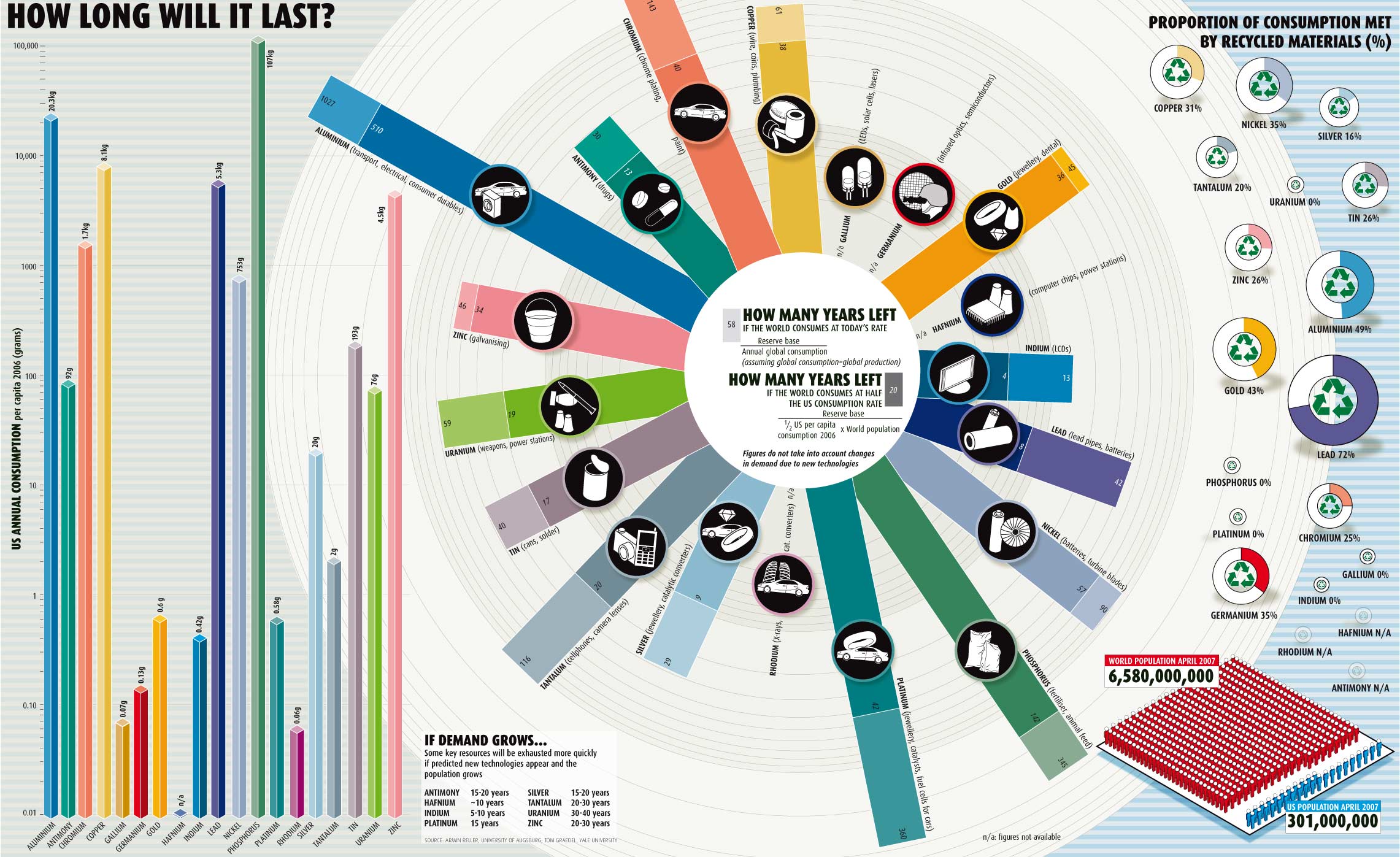
Infographic: How Long Will It Last?

http://intercontinentalcry.org/wp-content/uploads/2012/03/axHu1.jpg
Infographic by Armin Reller of the University of Augsburg and Tom Graedel of Yale University.

What happens when the world's supply of zinc runs out, followed by gold, copper, chromium, platinum, nickle and lead?

This 2009 infographic shows the consumption rate of these and other minerals and how much time before those supplies run out. It also shows how long those same minerals would last if the world’s per capita consumption rate was just half that of the United States.

This environmental infographic shows consumption levels of various materials and relative timelines until we run out of them. It also shows the impact of American consumption, in particular, and makes the point by showing the even worse spot we’d be in if the world’s per capita consumption rate was just half that of the United States.

Source: http://intercontinentalcry.org/infographic-how-long-will-it-last/

sexta-feira, 9 de março de 2012

Imposed Austerity vs Chosen Simplicity: Who Will Pay For Which Adjustments?

http://www.vandanashiva.org/

Vandana Shiva's ZSpace Page

The world is in ecological and economic meltdown. Ecological limits and limits set by human dignity and human equality are being ruthlessly violated. Adjustment is an imperative. However, there are vital ways that differentiate the adjustment by the rich and powerful and the processes of adjustment demanded by the popular will of people everywhere. The rich would like to make the poor and working people pay for adjustment. People want the rich to pay through higher taxes, including the Tobin Tax on financial transactions, and through regulation for stopping the robbery of natural resources and public goods.

The dominant economic model based on limitless growth on a limited planet is leading to an overshoot of the human use of the earth’s resources. This is leading to an ecological catastrophe. It is also leading to intense and violent resource grab of the remaining resources of the earth by the rich from the poor. The resource grab is an adjustment by the rich and powerful to a shrinking resource base – land, biodiversity, water – without adjusting the old resource intensive, limitless growth paradigm to the new reality. Its only outcome can be ecological scarcity for the poor in the short term, with deepening poverty and deprivation. In the long run it means the extinction of our species, as climate catastrophe and extinction of other species makes the planet un-inhabitable for human societies. Failure to make an ecological adjustment to planetary limits and ecological justice is a threat to human survival. The Green Economy being pushed at Rio +20 could well become the biggest resource grabs in human history with corporations appropriating the planet’s green wealth, the biodiversity, to become the green oil to make bio-fuel, energy plastics, chemicals – everything that the petrochemical era based on fossil fuels gave us. Movements worldwide have started to say “No to the Green Economy of the 1%”.

But an ecological adjustment is possible, and is happening. This ecological adjustment involves seeing ourselves as a part of the fragile ecological web, not outside and above it, immune from the ecological consequences of our actions. Ecological adjustment also implies that we see ourselves as members of the earth community, sharing the earth’s resources equitably with all species and within the human community. Ecological adjustment requires an end to resource grab, and the privatization of our land, bio diversity and seeds, water and atmosphere. Ecological adjustment is based on the recovery of the commons and the creation of Earth Democracy.

The dominant economic model based on resource monopolies and the rule of an oligarchy is not just in conflict with ecological limits of the planet. It is in conflict with the principles of democracy, and governance by the people, of the people, for the people. The adjustment from the oligarchy is to further strangle democracy and crush civil liberties and people’s freedom. Bharti Mittal’s statement that politics should not interfere with the economy reflects the mindset of the oligarchy that democracy can be done away with. This anti-democratic adjustment includes laws like homeland security in U.S., and multiple security laws in India.

The calls for a democratic adjustment from below are witnessed worldwide in the rise of non-violent protests, from the Arab spring to the American autumn of “Occupy” and the Russian winter challenging the hijack of elections and electoral democracy.

And these movements for democratic adjustment are also rising everywhere in response to the “austerity” programmes imposed by IMF, World Bank and financial institutions which created the financial crisis. The Third World had its structural Adjustment and Forced Austerity, through the 1980s and 1990s, leading to IMF riots. India’s structural adjustment of 1991 has given us the agrarian crisis with quarter million farmer suicides and food crisis pushing every 4th Indian to hunger and every 2nd Indian child to severe malnutrition; people are paying with their very lives for adjustment imposed by the World Bank/IMF. The trade liberalization reforms dismantled our food security system, based on universal PDS. It opened up the seed sector to seed MNCs. And now an attempt is being made through the Food Security Act to make our public feeding programmes a market for food MNCs. The forced austerity continues through imposition of so called reforms, such as Foreign Direct Investment (FDI) in retail, which would rob 50 million of their livelihoods in retail and millions more by changing the production system. Europe started having its forced austerity in 2010. And everywhere there are anti-austerity protests from U.K., to Italy, Greece, Spain, Ireland, Iceland, and Portugal. The banks which have created the crisis want society to adjust by destroying jobs and livelihoods, pensions and social security, public services and the commons. The people want financial systems to adjust to the limits set by nature, social justice and democracy. And the precariousness of the living conditions of the 99% has created a new class which Guy Standing calls the “Precariate”. If the Industrial Revolution gave us the industrial working class, the proletariat, globalization and the “free market” which is destroying the livelihoods of peasants in India and China through land grabs, or the chances of economic security for the young in what were the rich industrialized countries, has created a global class of the precarious. As Barbara Ehrenreich and John Ehrenreich have written in “The making of the American 99%”, this new class of the dispossessed and excluded include “middle class professional, factory workers, truck drivers, and nurses as well as the much poorer people who clean the houses, manicure the fingernails, and maintain the lawn of the affluent”.

Forced austerity based on the old paradigm allows the 1% super rich, the oligarchs, to grab the planets resources while pushing out the 99% from access to resources, livelihoods, jobs and any form of freedom, democracy and economic security. It is often said that with increasing growth, India and China are replicating the resource intensive and wasteful lifestyles of the Western countries. The reality is that while a small 3 to 4% of India is joining the mad race for consuming the earth with more and more automobiles and air conditioners, the large majority of India is being pushed into “de-consumption” – losing their entitlements to basic needs of food and water because of resource and land grab, market grab, and destruction of livelihoods. The hunger and malnutrition crisis in India is an example of the “de-consumption” forced on the poor by the rich, through the imposed austerity built into the trade liberalization and “economic reform” policies.

There is another paradigm emerging which is shared by Gandhi and the new movements of the 99%, the paradigm of voluntary simplicity of reducing one ecological foot print while increasing human well being for all. Instead of forced austerity that helps the rich become super rich, the powerful become totalitarian, chosen simplicity enables us all to adjust ecologically, to reduce over consumption of the planets resources, it allows us to adjust socially to enhance democracy and it creates a path for economic adjustment based on justice and equity.

Forced austerity makes the poor and working families pay for the excesses of limitless greed and accumulation by the super rich. Chosen simplicity stops these excesses and allow us to flower into an Earth Democracy where the rights and freedoms of all species and all people are protected and respected.

Source: http://www.zcommunications.org/imposed-austerity-vs-chosen-simplicity-who-will-pay-for-which-adjustments-by-vandana-shiva

segunda-feira, 5 de março de 2012

Green Washed: Why We Can't Buy Our Way to a Green Planet

http://igpub.com/green-washed/

“Kendra Pierre-Louis shows that consumer choices really do matter, but often not the way we think. Green Washed is a thoughtful and compelling book.”
—Elizabeth Kolbert

“If only we could buy our way (or recycle our way!) out of our environmental troubles. But as this slim and powerful book makes clear, what we need even more than clean cars are clean politics and economics that let us make sensible structural choices”
—Bill McKibben, author, Eaarth: Making a Life on a Tough New Planet

The message that our environment is in peril has filtered from environmental groups to the American consciousness to our shopping carts. Every day, millions of Americans dutifully replace conventional produce with organic, swap Mr. Clean for Seventh Generation, and replace their bottled water with water bottles. Many of us have come to believe that the path to environmental sustainability is paved by shopping green. Although this green consumer movement certainly has many Americans consuming differently, it raises an important and rarely asked question—”is this consumption really any better for the planet?”

By examining the major economic sectors of our society, including infrastructure (green housing), consumer goods (green clothing and jewelry), food (the rise of organic), and energy (including solar power and the popularity of the hybrid car), Green Washed: Why We Can’t Buy Our Way to a Green Planet explains that, though greener alternatives are important, we cannot simply buy our way to sustainability. Rather, if it is the volume of our consumption that matters, can we as a society dependent on constantly consuming ever be content with buying less?

A new and unique take on green consumption, Green Washed shows how buying better is only the first step toward true sustainability.

Kendra Pierre-Louis is the sustainable development editor for Justmeans.com. She holds a master’s degree in sustainable development from the SIT Graduate Institute in Vermont. She has created outreach material for the United Nations Environment Programme’s Convention on Biological Diversity and worked as a researcher for Terrapin Bright Green, an environmental consulting and strategic planning firm.

Read an excerpt of Green Washed (PDF)