Ya está en marcha la Cooperativa Integral Catalana, que cuenta con una central de compras, intercambios de bienes y servicios, y moneda social propia, el ecocoop.
Patricia Manrique (Redacción Cantabria)
Martes 15 de junio de 2010. Número 128
“El proyecto global es tratar de conseguir un embrión de nueva sociedad. Se trata de una cooperativa porque se tiene que relacionar con el sistema, pero sobre todo es un proyecto de construcción de una alternativa integral al capitalismo”, reflexiona Enric Durán, activista y miembro de la Cooperativa Integral Catalana puesta en marcha en mayo. Una iniciativa que tratará de cubrir todas las necesidades de sus socios –alimentación, vivienda, empleo, salud, educación, protección social y transporte– cortando progresivamente los lazos con el capitalismo.
El proyecto podría considerarse uno de los frutos del movimiento que implicó la publicación de Podemos! en marzo de 2009, donde ya se apuntaba la búsqueda de una alternativa al capitalismo. La Jornada de Huelga a la Banca del 17 de septiembre supuso otro paso, del que surgieron personas interesadas. Pero el empuje definitivo vino de la mano de las ecoxarxas, redes de ‘prosumidores’ conscientes, esto es, consumidores y productores, que se pusieron en marcha en Catalunya –en Tarragona, Montseny, Santa Coloma de Gramenet– y que “ayudaron a replantear la idea de la cooperativa integral, ya no sólo como un proyecto local, sino como un proyecto de coordinación de las ecoxarxas, integrando otras propuestas para salir del capitalismo”, señala Durán. Las ecoxarxas ya habían lanzado monedas sociales, algo que también ha hecho la Cooperativa Integral Catalana que, con el ecocoop, intercambiable por euros y equivalente con el resto de monedas sociales, pretende reducir la dependencia de las fluctuaciones financieras, implementar los intercambios locales y mejorar la capacidad adquisitiva de personas que no pueden trabajar, aun teniendo capacidades y conocimientos para hacerlo. El ecocoop “no es un almacén de valor”, remarca Durán, sino una simple unidad de medida de los intercambios, no genera intereses ni es escaso, y no tiene sentido acumularlo ni especular con él.
La figura jurídica de cooperativa ofrece un blindaje contra embargos privados o públicos, pues no puede tomarse acciones contra ella por las deudas de sus socios: únicamente hay que evitar el endeudamiento en nombre del colectivo, cuestión que recogen los estatutos. Así, se hace posible que insolventes, morosos y parados puedan vivir con toda normalidad, trabajando y consumiendo de manera autogestionada, sin tener que preocuparse por los embargos de deudas anteriores.
Las cooperativas disponen ya de una central de compras de productos ecológicos y locales y una red social comunal para el intercambio de productos y servicios. Otro de los grupos de trabajo busca proyectos de autoempleo vinculados a necesidades reales de los cooperativistas. Progresivamente, se pretende autogestionar la salud y la educación, y desearían generar un sistema de previsión social para garantizar las necesidades básicas de todos los miembros “en todo su recorrido vital”. El proyecto está alojado en la red social Redes en Red, puesta en marcha para la reunión que citó en Ruesta, durante cuatro días de abril, a decenas de activistas interesados en salir del capitalismo. En poco más de un mes, la cooperativa cuenta con un centenar de socios y media docena de núcleos locales en formación, además del núcleo gestor de Barcelona.
Fonte: http://www.diagonalperiodico.org/
segunda-feira, 9 de agosto de 2010
domingo, 8 de agosto de 2010
The Fallacy Of Growth
 |
| http://postgrowth.org/the-fallacy-of-growth/ |
Here’s a bit:
“In the short term, growth supports families, relieves social pressures that produce conflict and crime, pays for amenities such as the arts, offers opportunities for entrepreneurs and makes some of us exceedingly wealthy.
But growth is also an addiction. And, like most addictions, it threatens to destroy us. Not only does it clog our freeways, but it also paves farmland, wipes out open spaces, saddles taxpayers with ruinous development costs and crushes the quality of life that attracted us to our communities in the first place. Growth sucks irreplaceable resources out of the earth. It dumps poisonous pollution into our environment. It crowds out the planet’s other species and utterly fails to deliver the human happiness it promises…
It’s not as if nobody saw this coming. ‘The increase of wealth is not boundless,’ wrote John Stuart Mill in the mid-19th century. ‘The end of growth leads to a stationary state’…
Maybe it’s possible to get growth under control while keeping families fed and communities intact. The goal of steady-state economics is, after all, reasonable incomes for all human beings in a more humane society that preserves the planet and promotes human happiness. That’s a tall order. But we’ve satisfied tall orders before.
We can start on this one by questioning our near-universal assumption that growth is always good. And the next time a candidate promises unending growth, it wouldn’t hurt if somebody in the audience asked, ‘What for?’
After all, as Edward Abbey long ago pointed out, ‘Growth for the sake of growth is the ideology of the cancer cell.’”
Read the full article here.


sábado, 7 de agosto de 2010
The Truth About the Drug Companies

Written by Marcia Angell
During her two decades at The New England Journal of Medicine, Dr. Marcia Angell had a front-row seat on the appalling spectacle of the pharmaceutical industry. She watched drug companies stray from their original mission of discovering and manufacturing useful drugs and instead become vast marketing machines with unprecedented control over their own fortunes. She saw them gain nearly limitless influence over medical research, education, and how doctors do their jobs. She sympathized as the American public, particularly the elderly, struggled and increasingly failed to meet spiraling prescription drug prices. Now, in this bold, hard-hitting new book, Dr. Angell exposes the shocking truth of what the pharmaceutical industry has become–and argues for essential, long-overdue change.
Currently Americans spend a staggering $200 billion each year on prescription drugs. As Dr. Angell powerfully demonstrates, claims that high drug prices are necessary to fund research and development are unfounded: The truth is that drug companies funnel the bulk of their resources into the marketing of products of dubious benefit. Meanwhile, as profits soar, the companies brazenly use their wealth and power to push their agenda through Congress, the FDA, and academic medical centers.
Zeroing in on hugely successful drugs like AZT (the first drug to treat HIV/AIDS), Taxol (the best-selling cancer drug in history), and the blockbuster allergy drug Claritin, Dr. Angell demonstrates exactly how new products are brought to market. Drug companies, she shows, routinely rely on publicly funded institutions for their basic research; they rig clinical trials to make their products look better than they are; and they use their legions of lawyers to stretch out government-granted exclusive marketing rights for years. They also flood the market with copycat drugs that cost a lot more than the drugs they mimic but are no more effective.
The American pharmaceutical industry needs to be saved, mainly from itself, and Dr. Angell proposes a program of vital reforms, which includes restoring impartiality to clinical research and severing the ties between drug companies and medical education. Written with fierce passion and substantiated with in-depth research, The Truth About the Drug Companies is a searing indictment of an industry that has spun out of control.
sexta-feira, 6 de agosto de 2010
Limits to Growth - The 30-Year Update
 |
| http://www.chelseagreen.com/ |
"Reading the 30th-year update reminds me of why the systems approach to thinking about our future is not only valuable, but indispensable. Thirty years ago, it was easy for the critics to dismiss the limits to growth. But in today's world, with its collapsing fisheries, shrinking forests, falling water tables, dying coral reefs, expanding deserts, eroding soils, rising temperatures, and disappearing species, it is not so easy to do so. We are all indebted to the "Limits" team for reminding us again that time is running out."
Lester Brown, Earth Policy Institute
In 1972, three scientists from MIT created a computer model that analyzed global resource consumption and production. Their results shocked the world and created stirring conversation about global 'overshoot,' or resource use beyond the carrying capacity of the planet. Now, preeminent environmental scientists Donnella Meadows, Jorgen Randers, and Dennis Meadows have teamed up again to update and expand their original findings in The Limits to Growth: The 30 Year Update.
Meadows, Randers, and Meadows are international environmental leaders recognized for their groundbreaking research into early signs of wear on the planet. Citing climate change as the most tangible example of our current overshoot, the scientists now provide us with an updated scenario and a plan to reduce our needs to meet the carrying capacity of the planet.
Over the past three decades, population growth and global warming have forged on with a striking semblance to the scenarios laid out by the World3 computer model in the original Limits to Growth. While Meadows, Randers, and Meadows do not make a practice of predicting future environmental degradation, they offer an analysis of present and future trends in resource use, and assess a variety of possible outcomes.
In many ways, the message contained in Limits to Growth: The 30-Year Update is a warning. Overshoot cannot be sustained without collapse. But, as the authors are careful to point out, there is reason to believe that humanity can still reverse some of its damage to Earth if it takes appropriate measures to reduce inefficiency and waste.
Written in refreshingly accessible prose, Limits to Growth: The 30-Year Update is a long anticipated revival of some of the original voices in the growing chorus of sustainability. Limits to Growth: The 30 Year Update is a work of stunning intelligence that will expose for humanity the hazy but critical line between human growth and human development.
quarta-feira, 4 de agosto de 2010
Peak Capital - Our Ultimate Limit?
Posted by Ugo Bardi on August 4, 2010 - 10:30am in The Oil Drum: Europe
This post was published in June 2009 under the name The Fifth Problem: Peak Capital.
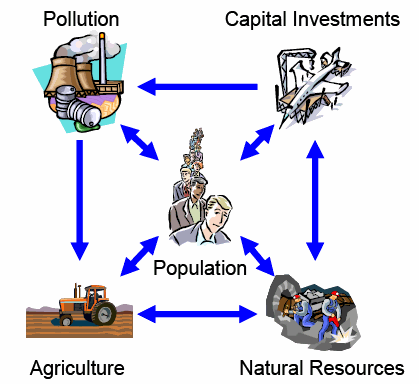
The five main elements of the world model developed in "The Limits to Growth" study according to Magne Myrtveit .
What's happening here? The GPS system is a pinnacle of modern technology, a demonstration that the thing we call "progress" exists. If you have a car navigator, the idea of going back to clumsy printed maps just seems impossible. And that is just one of the many uses of the GPS system. How come that we left such an important system degrade? How can it be that someone forgot that satellites need to be replaced after a while?
The degradation of the GPS system may be attributed to mistakes, incompetence, bureaucracy or even conspiracies. But the problem may lie at a much deeper level. It may be a symptom of the degradation of the whole economy. But why is this happening? People mention evil banking practices, speculation, subprimes, terrorism, and what you have. But, with so many things going on at the same time, what is really the origin of the problems and what is just a consequence of other factors? To find an answer, you need to understand how the world's economic system works. One of the first attempts to do that in a comprehensive way was the 1972 report to the Club of Rome known as "The Limits to Growth" (LTG).
The LTG study was based on a rather complex model which, however, can be summarized in terms of five main elements, as you see in the figure at the beginning of this post. The five elements are 1) population, 2) mineral resources, 3) agricultural resources, 4) pollution and 5) capital investments. This is just one of the many ways to build such a model. Other choices are possible, but the LTG model, improved over the years, is a good way to capture the essential elements of the world's economy. Despite the persistent legend that the LTG study was "wrong"; the results of the study have been found to be remarkably accurate.
None of the five elements of the model is a problem in itself. But each one can become a problem. In that case, we speak of 1) overpopulation, 2) mineral depletion, 3) famine, 4) ecosystem collapse and 5) economic decline. Often, these five problems are considered as if they were independent from each other. People tend to attribute all what is going on to a single problem: peak oil, climate change, overpopulation, and so on. In particular, economists tend to see the economy as independent from the availability of natural resources. Of course, this cannot be true and in a "dynamic" model, such as the LTG one, all the elements of the economic system interact with each other; either reinforcing each other (positive feedback) or weakening each other (negative feedback). To understand how the economy behaves as the natural resources are exploited (and overexploited) it is important to consider the role of the "capital" parameter. The behavior of the capital stock directly affects industrial production and other parameters which are counted as part of economic indicators such as the gross domestic product (GDP).
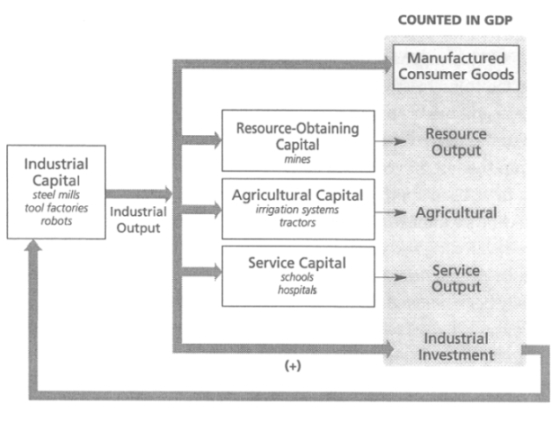
In the LTG world model, "capital" is created by investments generated by industrial activity. Capital is assumed to decay at a rate proportional to the amount of existing capital. This is called obsolescence or, sometimes, depreciation. To keep capital growing, or at least not disappearing, investments need to be larger than, or as large as, depreciation. Since investments depend on the availability of natural resources, the buildup (or the dissipation) of the capital stock depend on the progressive depletion of these resources. In the original LTG model of 1972, there were three kinds of capital stocks considered: industrial capital (factories, machines, etc.), service capital (schools, bridges, hospitals, etc.) and agricultural capital (farms, land, machinery, etc.). In the latest version (2004), industrial capital and mining capital are considered separately, as you see in the following figure ( from the synopsis of the 30 year update of LTG). Note how the "capital" parameter (in its various forms) affects the parameters which determine the GDP.
Here is a very clear description of how capital interacts with the other elements of the world model in a synopsis written in 1972 by the authors of the LTG report:
The industrial capital stock grows to a level that requires an enormous input of resources. In the very process of that growth it depletes a large fraction of the resource reserves available. As resource prices rise and mines are depleted, more and more capital must be used for obtaining resources, leaving less to be invested for future growth. Finally investment cannot keep up with depreciation, and the industrial base collapses, taking with it the service and agricultural systems, which have become dependent on industrial inputs.
Here are the results of these interactions, expressed in graphical form as what is called the "standard run" or "base case model" of the LTG study (from the 2004 edition)
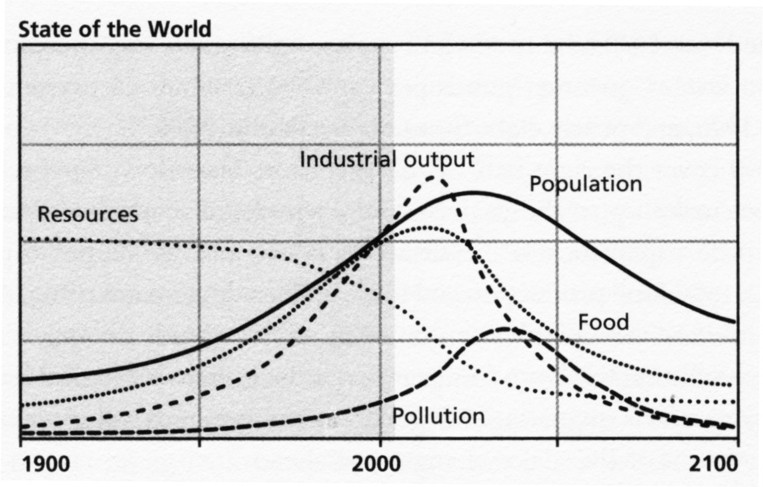
In the graph, you don't see the "capital" parameter plotted. However, industrial capital follows the same curve of industrial production. The other forms of capital have a similar behavior. All reach a maximum level and then decline, carrying the whole economy down with them. Overall, it is "peak capital."
When do we expect peak capital to occur? According to the "standard run" of the LTG report, it may arrive during the first two decades of the century. It may very well be that much of what we are seeing now is a symptom of peak capital approaching: airports, roads, bridges, dikes, dams, and about everything that goes under the name of "infrastructure" are decaying everywhere in the world. The whole economic system is becoming unable to maintain the level of complexity that it had reached just a few decades ago.
So, the degradation of the world' GPS system is not something unexpected, nor it is unrelated to such problems as peak oil or the depletion of mineral resources. It is just another kind of peak: "peak capital." Maybe GAO has been too pessimistic; maybe we'll decide that the GPS system is so important that we can't let it decay. But, in any case, it is a sign of the times: the fifth problem.
_________________________
Two posts by Ugo Bardi on "The Limits to Growth"
Cassandra's curse: how the limits to growth was demonized
Peak oil and The Limits to Growth: two parallel stories
Other "Limits to Growth" posts:
Dennis Meadows - Economics and Limits to Growth: What's Sustainable? - By Gail the Actuary New World Model - EROEI Issues - Guest post by Delores García
Limits to Growth Article Worth Another Look by Dave Murphy
This post was published in June 2009 under the name The Fifth Problem: Peak Capital.
What's happening here? The GPS system is a pinnacle of modern technology, a demonstration that the thing we call "progress" exists. If you have a car navigator, the idea of going back to clumsy printed maps just seems impossible. And that is just one of the many uses of the GPS system. How come that we left such an important system degrade? How can it be that someone forgot that satellites need to be replaced after a while?
The degradation of the GPS system may be attributed to mistakes, incompetence, bureaucracy or even conspiracies. But the problem may lie at a much deeper level. It may be a symptom of the degradation of the whole economy. But why is this happening? People mention evil banking practices, speculation, subprimes, terrorism, and what you have. But, with so many things going on at the same time, what is really the origin of the problems and what is just a consequence of other factors? To find an answer, you need to understand how the world's economic system works. One of the first attempts to do that in a comprehensive way was the 1972 report to the Club of Rome known as "The Limits to Growth" (LTG).
The LTG study was based on a rather complex model which, however, can be summarized in terms of five main elements, as you see in the figure at the beginning of this post. The five elements are 1) population, 2) mineral resources, 3) agricultural resources, 4) pollution and 5) capital investments. This is just one of the many ways to build such a model. Other choices are possible, but the LTG model, improved over the years, is a good way to capture the essential elements of the world's economy. Despite the persistent legend that the LTG study was "wrong"; the results of the study have been found to be remarkably accurate.
None of the five elements of the model is a problem in itself. But each one can become a problem. In that case, we speak of 1) overpopulation, 2) mineral depletion, 3) famine, 4) ecosystem collapse and 5) economic decline. Often, these five problems are considered as if they were independent from each other. People tend to attribute all what is going on to a single problem: peak oil, climate change, overpopulation, and so on. In particular, economists tend to see the economy as independent from the availability of natural resources. Of course, this cannot be true and in a "dynamic" model, such as the LTG one, all the elements of the economic system interact with each other; either reinforcing each other (positive feedback) or weakening each other (negative feedback). To understand how the economy behaves as the natural resources are exploited (and overexploited) it is important to consider the role of the "capital" parameter. The behavior of the capital stock directly affects industrial production and other parameters which are counted as part of economic indicators such as the gross domestic product (GDP).
In the LTG world model, "capital" is created by investments generated by industrial activity. Capital is assumed to decay at a rate proportional to the amount of existing capital. This is called obsolescence or, sometimes, depreciation. To keep capital growing, or at least not disappearing, investments need to be larger than, or as large as, depreciation. Since investments depend on the availability of natural resources, the buildup (or the dissipation) of the capital stock depend on the progressive depletion of these resources. In the original LTG model of 1972, there were three kinds of capital stocks considered: industrial capital (factories, machines, etc.), service capital (schools, bridges, hospitals, etc.) and agricultural capital (farms, land, machinery, etc.). In the latest version (2004), industrial capital and mining capital are considered separately, as you see in the following figure ( from the synopsis of the 30 year update of LTG). Note how the "capital" parameter (in its various forms) affects the parameters which determine the GDP.
Here is a very clear description of how capital interacts with the other elements of the world model in a synopsis written in 1972 by the authors of the LTG report:
The industrial capital stock grows to a level that requires an enormous input of resources. In the very process of that growth it depletes a large fraction of the resource reserves available. As resource prices rise and mines are depleted, more and more capital must be used for obtaining resources, leaving less to be invested for future growth. Finally investment cannot keep up with depreciation, and the industrial base collapses, taking with it the service and agricultural systems, which have become dependent on industrial inputs.
Here are the results of these interactions, expressed in graphical form as what is called the "standard run" or "base case model" of the LTG study (from the 2004 edition)
In the graph, you don't see the "capital" parameter plotted. However, industrial capital follows the same curve of industrial production. The other forms of capital have a similar behavior. All reach a maximum level and then decline, carrying the whole economy down with them. Overall, it is "peak capital."
When do we expect peak capital to occur? According to the "standard run" of the LTG report, it may arrive during the first two decades of the century. It may very well be that much of what we are seeing now is a symptom of peak capital approaching: airports, roads, bridges, dikes, dams, and about everything that goes under the name of "infrastructure" are decaying everywhere in the world. The whole economic system is becoming unable to maintain the level of complexity that it had reached just a few decades ago.
So, the degradation of the world' GPS system is not something unexpected, nor it is unrelated to such problems as peak oil or the depletion of mineral resources. It is just another kind of peak: "peak capital." Maybe GAO has been too pessimistic; maybe we'll decide that the GPS system is so important that we can't let it decay. But, in any case, it is a sign of the times: the fifth problem.
_________________________
Two posts by Ugo Bardi on "The Limits to Growth"
Cassandra's curse: how the limits to growth was demonized
Peak oil and The Limits to Growth: two parallel stories
Other "Limits to Growth" posts:
Dennis Meadows - Economics and Limits to Growth: What's Sustainable? - By Gail the Actuary New World Model - EROEI Issues - Guest post by Delores García
Limits to Growth Article Worth Another Look by Dave Murphy
segunda-feira, 2 de agosto de 2010
La corrupción de la democracia
Ignacio Ramonet – Consejo Científico de ATTAC España
El “caso Bettencourt” que zarandea Francia con su vendaval de arrestos, odios familiares, cheques ocultos, grabaciones furtivas, fechorías fiscales y donaciones ilegales al partido del Presidente Nicolas Sarkozy, está hundiendo el país en una profunda crisis moral.
Liliane Bettencourt, una de las mujeres más ricas del planeta, poseedora de una fortuna de 17.000 millones de euros y propietaria del imperio de cosméticos y perfumes L’Oréal, se halla en el epicentro de un alucinante culebrón devenido asunto de Estado. Unas conversaciones robadas en su domicilio revelaron que el ministro de Trabajo, Eric Woerth, usó de su influencia (cuando era ministro del Presupuesto, y por consiguiente responsable de la administración fiscal) para obtener que su esposa, Florence, fuese contratada por la multimillonaria -con un salario anual de 200.000 euros- para administrar su fortuna… De paso, Eric Woerth, que también era tesorero del partido del Presidente, percibió presuntamente donaciones de decenas de miles de euros (1) para financiar la campaña electoral de Sarkozy… A cambio, se sospecha que el ministro hizo la vista gorda sobre una parte del patrimonio oculto de la dueña de L’Oréal: por ejemplo, varias cuentas millonarias en Suiza y una isla en las Seychelles valorada en unos 500 millones de euros…
Este asunto, de por sí bochornoso, adquiere mayor morbo en la medida en que Eric Woerth es el encargado de conducir la dura reforma de las jubilaciones que castigará a millones de asalariados modestos. En un ambiente de fuertes tensiones sociales y de motines de desclasados en los guetos urbanos, el “caso Bettencourt” está reactivando el viejo litigio entre las elites y el pueblo común. “El clima de la sociedad, advierte el filósofo Marcel Gauchet, se halla hoy impregnado de revuelta latente y de un sentimiento de distancia radical hacia los dirigentes” (2).
Francia no es la única democracia carcomida por la corrupción de algunos políticos y por la permanente confusión que muchos de ellos mantienen entre cargos públicos y beneficios privados. Está aún fresco en las memorias el escándalo de los abusos de los gastos parlamentarios a expensas de los contribuyentes, ocurrido en el Reino Unido y que, junto con otras causas, provocó el descalabro de los laboristas en las elecciones del 6 de mayo pasado. O el de la Italia de Silvio Berlusconi en donde, casi veinte años después de la operación mane pulite que decapitó a gran parte de la clase política, la corrupción, a modo de metástasis, vuelve a extenderse ante la impotencia de una izquierda paralizada y sin ideas. El Tribunal de Cuentas italiano, en su último informe, establece que los delitos de corrupción activa de los funcionarios públicos aumentaron el año pasado en más de 150% (3). Y qué decir de España, agobiada por los múltiples casos de corrupción de cargos públicos asociados a los “señores del ladrillo” enriquecidos por las delirantes políticas urbanísticas. Sin hablar del esperpéntico “caso Gürtel” que sigue coleando.
A escala internacional, la corrupción alcanza hoy, en la era de la globalización neoliberal, una dimensión estructural. Su práctica se ha banalizado igual que otras formas de criminalidad corruptora: malversación de fondos, manipulación de contratos públicos, abuso de bienes sociales, creación y financiación de empleos ficticios, fraude fiscal, disimulo de capitales procedentes de actividades ilícitas, etc. Se confirma así que la corrupción es un pilar fundamental del capitalismo. El ensayista Moisés Naím afirma que, en los próximos decenios, “las actividades de las redes ilícitas del tráfico global y sus socios del mundo ‘legítimo’, ya sea gubernamental o privado, tendrán muchísimo más impacto en las relaciones internacionales, las estrategias de desarrollo económico, la promoción de la democracia, los negocios, las finanzas, las migraciones, la seguridad global; en fin, en la guerra y la paz, que lo que hasta ahora ha sido comúnmente imaginado” (4).
Según el Banco Mundial, cada año, en el planeta, los flujos de dinero procedentes de la corrupción, de actividades delictivas y de la evasión de fondos hacia los paraísos fiscales alcanza la astronómica suma de 1,6 billones de euros… De ese montante, unos 250 000 millones corresponden al fraude fiscal realizado anualmente sólo en la Unión Europea. Reinyectados en la economía legal, esos millones permitirían evitar los actuales planes de austeridad y ajuste que tantos estragos sociales están causando.
Ningún dirigente debe olvidar que la democracia es esencialmente un proyecto ético, basado en la virtud y en un sistema de valores sociales y morales que dan sentido al ejercicio del poder. Afirma José Vidal-Beneyto, en su libro póstumo y de indispensable lectura, que cuando, en una democracia, “las principales fuerzas políticas, en plena armonía mafiosa, se ponen de acuerdo para timar a los ciudadanos” (5) se produce un descrédito de la democracia, una repulsa de la política, un aumento de la abstención y, más peligroso, una subida de la extrema derecha. Y concluye: “El gobierno se corrompe por la corrupción, y cuando hay corrupción en la democracia, la corrompida es la democracia”.
Artículo publicado en Le Monde diplomatique.
Notas:
(1) En Francia, la ley de financiamiento de los partidos políticos del 11 de abril de 2003, limita las donaciones de las personas físicas a 7.500 euros al año.
(2) Le Monde , París, 18 de julio de 2010.
(3) Clarín , Buenos Aires, 17 de febrero de 2010.
(4) Moisés Naím, Ilícito , Debate, Madrid, 2006.
(5) José Vidal-Beneyto, La corrupción de la democracia , Catarata, Madrid, 2010.
Fonte: http://www.attac.es/la-corrupcion-de-la-democracia/
El “caso Bettencourt” que zarandea Francia con su vendaval de arrestos, odios familiares, cheques ocultos, grabaciones furtivas, fechorías fiscales y donaciones ilegales al partido del Presidente Nicolas Sarkozy, está hundiendo el país en una profunda crisis moral.
Liliane Bettencourt, una de las mujeres más ricas del planeta, poseedora de una fortuna de 17.000 millones de euros y propietaria del imperio de cosméticos y perfumes L’Oréal, se halla en el epicentro de un alucinante culebrón devenido asunto de Estado. Unas conversaciones robadas en su domicilio revelaron que el ministro de Trabajo, Eric Woerth, usó de su influencia (cuando era ministro del Presupuesto, y por consiguiente responsable de la administración fiscal) para obtener que su esposa, Florence, fuese contratada por la multimillonaria -con un salario anual de 200.000 euros- para administrar su fortuna… De paso, Eric Woerth, que también era tesorero del partido del Presidente, percibió presuntamente donaciones de decenas de miles de euros (1) para financiar la campaña electoral de Sarkozy… A cambio, se sospecha que el ministro hizo la vista gorda sobre una parte del patrimonio oculto de la dueña de L’Oréal: por ejemplo, varias cuentas millonarias en Suiza y una isla en las Seychelles valorada en unos 500 millones de euros…
Este asunto, de por sí bochornoso, adquiere mayor morbo en la medida en que Eric Woerth es el encargado de conducir la dura reforma de las jubilaciones que castigará a millones de asalariados modestos. En un ambiente de fuertes tensiones sociales y de motines de desclasados en los guetos urbanos, el “caso Bettencourt” está reactivando el viejo litigio entre las elites y el pueblo común. “El clima de la sociedad, advierte el filósofo Marcel Gauchet, se halla hoy impregnado de revuelta latente y de un sentimiento de distancia radical hacia los dirigentes” (2).
Francia no es la única democracia carcomida por la corrupción de algunos políticos y por la permanente confusión que muchos de ellos mantienen entre cargos públicos y beneficios privados. Está aún fresco en las memorias el escándalo de los abusos de los gastos parlamentarios a expensas de los contribuyentes, ocurrido en el Reino Unido y que, junto con otras causas, provocó el descalabro de los laboristas en las elecciones del 6 de mayo pasado. O el de la Italia de Silvio Berlusconi en donde, casi veinte años después de la operación mane pulite que decapitó a gran parte de la clase política, la corrupción, a modo de metástasis, vuelve a extenderse ante la impotencia de una izquierda paralizada y sin ideas. El Tribunal de Cuentas italiano, en su último informe, establece que los delitos de corrupción activa de los funcionarios públicos aumentaron el año pasado en más de 150% (3). Y qué decir de España, agobiada por los múltiples casos de corrupción de cargos públicos asociados a los “señores del ladrillo” enriquecidos por las delirantes políticas urbanísticas. Sin hablar del esperpéntico “caso Gürtel” que sigue coleando.
A escala internacional, la corrupción alcanza hoy, en la era de la globalización neoliberal, una dimensión estructural. Su práctica se ha banalizado igual que otras formas de criminalidad corruptora: malversación de fondos, manipulación de contratos públicos, abuso de bienes sociales, creación y financiación de empleos ficticios, fraude fiscal, disimulo de capitales procedentes de actividades ilícitas, etc. Se confirma así que la corrupción es un pilar fundamental del capitalismo. El ensayista Moisés Naím afirma que, en los próximos decenios, “las actividades de las redes ilícitas del tráfico global y sus socios del mundo ‘legítimo’, ya sea gubernamental o privado, tendrán muchísimo más impacto en las relaciones internacionales, las estrategias de desarrollo económico, la promoción de la democracia, los negocios, las finanzas, las migraciones, la seguridad global; en fin, en la guerra y la paz, que lo que hasta ahora ha sido comúnmente imaginado” (4).
Según el Banco Mundial, cada año, en el planeta, los flujos de dinero procedentes de la corrupción, de actividades delictivas y de la evasión de fondos hacia los paraísos fiscales alcanza la astronómica suma de 1,6 billones de euros… De ese montante, unos 250 000 millones corresponden al fraude fiscal realizado anualmente sólo en la Unión Europea. Reinyectados en la economía legal, esos millones permitirían evitar los actuales planes de austeridad y ajuste que tantos estragos sociales están causando.
Ningún dirigente debe olvidar que la democracia es esencialmente un proyecto ético, basado en la virtud y en un sistema de valores sociales y morales que dan sentido al ejercicio del poder. Afirma José Vidal-Beneyto, en su libro póstumo y de indispensable lectura, que cuando, en una democracia, “las principales fuerzas políticas, en plena armonía mafiosa, se ponen de acuerdo para timar a los ciudadanos” (5) se produce un descrédito de la democracia, una repulsa de la política, un aumento de la abstención y, más peligroso, una subida de la extrema derecha. Y concluye: “El gobierno se corrompe por la corrupción, y cuando hay corrupción en la democracia, la corrompida es la democracia”.
Artículo publicado en Le Monde diplomatique.
Notas:
(1) En Francia, la ley de financiamiento de los partidos políticos del 11 de abril de 2003, limita las donaciones de las personas físicas a 7.500 euros al año.
(2) Le Monde , París, 18 de julio de 2010.
(3) Clarín , Buenos Aires, 17 de febrero de 2010.
(4) Moisés Naím, Ilícito , Debate, Madrid, 2006.
(5) José Vidal-Beneyto, La corrupción de la democracia , Catarata, Madrid, 2010.
Fonte: http://www.attac.es/la-corrupcion-de-la-democracia/
domingo, 1 de agosto de 2010
SHADOW ELITE
 How the World's New Power Brokers Undermine Democracy, Government, and the Free Market
 (Basic Books; December 1, 2009)
Janine R. Wedel
Governments and administrations come and go, but not so a new breed of power brokers, who always seem to pop up just where the action is. Wearing different hats, they press their agendas in venue after venue. According to award-winning public policy scholar and anthropologist Janine Wedel, these are the "shadow elite," the prime movers in a vexing new system of power and influence.
Wedel charts how these players make public decisions without public input—in realms from domestic to foreign and financial policy. Maneuvering through their many spheres of influence, they challenge both governments' rules of accountability and businesses' codes of competition, ultimately answering only to each other. From the Harvard economists who helped privatize post-Soviet Russia and the neoconservatives who helped privatize American foreign policy for thirty years (culminating with the debacle that is Iraq) to many lesser-known global operators, these players flout once-sacrosanct boundaries between state and private, bureaucracy and market. This new breed, unseen by most, is steadily gaining power.
Original and eye-opening, Shadow Elite gives us the tools we need to recognize these players and understand the new system—which we ignore at our peril.
http://janinewedel.info/shadowelite.html
Subscrever:
Mensagens (Atom)