Mostrar mensagens com a etiqueta ECOLOGICAL ECONOMICS. Mostrar todas as mensagens

terça-feira, 16 de outubro de 2012

Enough is Enough : Ideas for a Sustainable Economy in a World of Finite Resources

http://steadystate.org/enough-is-enough/
  • Do you suspect that the idea of perpetual economic growth on a finite planet is folly?
  • Are you searching for ways to solve our profound social and environmental problems?
  • Do you want to know how we can construct an economy that (1) meets our needs without undermining the life-support systems of the planet and (2) achieves sustainable and equitable well-being for all people?
Read Enough is Enough for answers to these questions!

The report is available in three languages:

Summary (10 pages): EN ES FR
Full Report (130 pages): EN ES

Click here to view a collection of related videos.

Enough is Enough is the single most complete collection of policy initiatives, tools, and reforms for an economy that makes enough its goal instead of more. The report, generated from the inspirational ideas of the Steady State Economy Conference, consists of three parts:
  • Part One describes why economic growth is becoming an obsolete goal and provides a crystal-clear description of the desirable alternative — a steady state economy;
  • Part Two examines ten key areas where change is needed to achieve a steady state economy;
  • Part Three provides a blueprint for moving boldly from ideas to action.
The suggested citation for the report is:

O’Neill, D.W., R. Dietz, and N. Jones (editors). 2010. Enough is Enough: Ideas for a Sustainable Economy in a World of Finite Resources. The Report of the Steady State Economy Conference. Center for the Advancement of the Steady State Economy (Arlington, Virginia, USA) and Economic Justice for All (Leeds, UK).

Please read the report, discuss the ideas contained in it, and do what you can to help get us on the path to a better economy. If you are interested in engaging with others in online discussions of report topics, then please visit the SteadyStaters Google Group and request an invitation to join.

segunda-feira, 11 de junho de 2012

A Conversation with Herman Daly

We are grateful to Herman Daly for chatting with us on a range of topics from ecology to economics, policy to politics, relocalization to religion. He is Emeritus Professor at the University of Maryland School of Public Policy, pioneered work on Steady-State and Ecological Economics, and has received more accolades and written more books than we can mention. Find more about Steady-State Economics at steadystate.org, and reach out to your elected officials about the need to transition to a steady-state economy.

You have been making a persuasive case for a steady-state economy (SSE) for several decades now. In that time, we’ve gone well into ecological overshoot. The Limits to Growth scenarios indicate it may no longer be possible to avoid decline/collapse as delayed negative effects begin to kick in. What gives you hope that a transition to a steady-state economy is still possible?

The steady state to which we might now transition will be a smaller and more impoverished one than our existing level, or one that we could have attained if we had started sooner. A small amount of optimism comes from the fact that growth has become uneconomic and our self-interest may help us recognize that, once we properly measure costs and benefits. But beyond such limited rational optimism is faith-based hope. If one believes the world is in some sense a creation rather than a random accident, and that purpose can be independently causative in the physical world, albeit within limits, then there is a basis for hope. If one believes that purpose (final causation) is an illusion, a trick evolution played on us, as many materialists affirm, then we might as well forget it all anyway and try to “have fun” while it lasts.

In control systems, two properties that are important, among others, are convergence and stability—that is, how well, if at all, does the system move towards the desired operating point, and how well does it stay there once it arrives at that point.

Regarding convergence, do you think there’s a way to arrest the harmful, delayed feedbacks that are already underway using the levers of SSE? It seems one of the fundamental issues in an economic or industrial system is the feedback delay between changes in the system and their effects; it’s this dynamic that Meadows et al. observed as causing overshoot and decline/collapse. How might you avoid this in a steady-state system, especially when the delayed feedback can be in the form of a problem that develops for years before scientists even become aware of it (e.g. the ozone hole), let alone form a consensus (e.g. climate change)?

I don’t think of a SSE as automatically converging to a stable operating point, but more as a system whose inherent tendency is to outgrow its parent system, and which must therefore be externally constrained. Thus the equilibrium will be at a limit, and the important thing is to set that limit within the larger carrying capacity and carefully enforce it. (This is an important difference with neoclassical environmental economists who think they can make the economy internally convergent and stable by just “getting prices right” and putting a price on everything). The uncertainty about where the limits are, and the delayed feedback from exceeding them are very real problems, and the only “answer” I have is to slow down and leave a bigger margin for ignorance—the so-called precautionary principle—as I am told the engineers do—design a bridge you think will last, and then double its strength for good measure.

Might there be an analogous stability problem to The Energy Trap that arises out of political myopia, in which there is an incentive to rig the system once it has arrived at the steady-state target to squeeze a little bit of short-term gain out of it? What might be done to keep politicians (and those that support and elect them) from changing the rules of the game in this way for temporary benefit? (Might there be broader, more permanent rules, akin to Alaska’s constitutional mandate on sustainable fishing, that would prevent such action?)

The more one specifies permanent rules the less able one is to make adjustments to meet changing conditions. Any system can be subverted by the people running it—witness the repeal of the Glass-Steagall Act. The quest for a “system so perfect that no one needs to be good” (T.S. Eliot) is likely to fail.

Suppose you could make every layperson familiar with one economic concept. What would it be, and why? Given the kind of reportage we get on matters economic, what should people be paying attention to, and what should just be ignored?

I suppose it would be “opportunity cost”, the worth of the next best alternative to the one chosen, the best set of opportunities sacrificed in making a choice. Don’t worry about monetizing it at first, just make a list (without double counting) of the most important things you can’t do because of what you chose to do, and calmly think about whether your chosen alternative would really be worth it. Then try to monetize the cost. We should ignore incessant reportage on the Dow-Jones, and GDP growth, and demand better reporting and measurement of unemployment, income distribution, and rates of depletion and pollution.

How can the concept of opportunity cost help laypersons? Does it help them make choices in daily life? If so, what might be an example? Or is it better for evaluating candidate policies?

Suppose I want to become a great singer, but have limited talent. Maybe I just need to devote all my time and energy to singing and practicing. But what else could I be doing with my time and energy—what opportunities am I sacrificing in my quest to become a great singer? Is it worth it?—A very commonsense idea.

You have argued that GDP conflates utility and throughput; might there be some simple definition or definitions of utility that could be computed using statistics collected by governments today? (Are the Human Development Index, Genuine Progress Indicator, and others like them good proxies for utility?)

GPI is an objective index of utility, and self-evaluated happiness is a subjective index—both show a positive correlation with GDP up to a point beyond which GDP continues to rise and the utility index becomes flat. So although there is no direct measure of utility, there is good evidence that, beyond a sufficiency, GDP growth does not increase it.

How would you sell SSE to someone whose understanding of economics comes from the nightly news—one dominated by growth, the stock market, and unemployment data? How would you sell steady-state economic policy to progressives / liberals vs. conservatives?

I would point out that all the growth has gone to the rich, and that the poor have actually lost ground in the last few decades, so the claim that growth will cure poverty has proven false. As for the stock market—the Dow-Jones is mostly meaningless day-to-day noise, but the recent crash brought on by over leverage and fraudulent financial manipulation should make one very wary of the stock market—and indeed of our fractional reserve banking system. It should convince us of the need to move toward 100% reserve requirements and to break-up large banks. Unemployment statistics are an important feedback that reflects large loss of welfare, and the figures are usually underestimated. It used to be that full employment was the goal and growth in GDP the means to it. Now growth is the goal, and off-shoring jobs, merger, and automation, which increase unemployment, are the means. Since liberals are as afraid of a steady state as conservatives, I would make the same points to them.

The highest-profile source—or vehicle, really—of information about the massive gains for the rich since 1970 is Occupy Wall Street. And thinking about OWS brings many questions to mind. Although there was some misleading coverage of OWS, especially at first, for a few weeks the mainstream media were showing people with economic grievances, and taking them seriously. And OWS also took issue explicitly with the engineers of the 2008 financial crisis.

Nonetheless, Occupy Wall Street has been effectively disappeared from media coverage, the camps displaced, and the issues dismissed by ad hominem—e.g. it’s only lazy hippies who complain. Is this a sign that the information people need is inherently unwelcome? Was OWS the wrong spokesmovement for economic justice?

No, I think they had as much impact as possible, given that Wall Street owns the media.

Do you still believe that “it will probably take a Great Ecological Spasm to convince people that something is wrong with an economic theory that denies the very possibility of an economy exceeding its optimal scale” (as you wrote in 1987)? (Or for a real paradigm shift to happen will it require, to put Kuhn’s observation nicely, that today’s conventional economists retire?) Have we foreclosed some outcomes having waited over twenty years from that writing?

Yes. The financial crisis of 2008 and continuing recession have not been enough—indeed they have placed growth even more front and center because it is the only “solution” economists and politicians can imagine. I used to expect a Kuhnian paradigm shift as old economists died off, but they seem to be cloning themselves in university economics departments faster than they are dying. As noted above we have certainly foreclosed some options by delay, and the Millennial generation of economists do not seem to be an improvement, with the exception of ecological economists who are still very rare in academic economics departments. I hope the new generation will not be bluffed by their economists, but will insist on better answers to critical questions.

In For the Common Good, you made a compelling case for the revitalization of communities, and for bottom-up rethinking of social arrangements. It seems however that there are structural economic and political barriers that communities face if they try to relocalize: everything from outsourced manufacturing to the Commerce Clause. What might be some ways around this? Might it require informal / gray-market local economies or policies (and might local currencies, timebanks, and other similar mechanisms play a role)?

Of course one way is global crash followed by reconstruction at more local and national levels. Increasing energy and transportation costs could bring about re-localization more gradually. Off-shoring production and global economic integration is a sell-out of the working class in the interest of transnational corporations, and at some point has to be politically resisted. The disintegration of the Eurozone may be the first step in re-localization. Local currencies as a supplement to national currencies are a good idea especially for depressed areas that have to export to the national economy just to earn cash with which to transact even local exchanges. The fallacies of free trade and globalization are discussed in For the Common Good, chapter 11. I think the first step in re-localization is to de-globalize or re-nationalize. Relatively independent nations can trade for mutual benefit, but extreme specialization means you must trade. If trade is no longer voluntary there is no reason to expect it to be mutually beneficial.

Have we in the United States (and, to a lesser extent, Europe and the rest of the industrialized world) reached a point of diminishing returns not just in terms of EROEI but in something related: the return we get from tapping the resources of nations around the globe via economic (and military) means? Is there a means by which we in the United States can extricate ourselves from our involvement in and wealth-siphoning from countless nations around the globe in a way that isn’t severely damaging both for us and the nations in question?

Already wars are caused by competition for remaining oil, and increasingly for agricultural land and water. Growth economies will be driven to resource wars, and avoiding that is a major reason for steady state economies. R & D should go into improving resource productivity, not into military weapons for gaining access to remaining resources. Move away from globalization (integrated world economy dominated by transnational corporations) toward trade among interdependent but relatively self-sufficient national economies, as was envisioned at Bretton Woods, and then abandoned with the later formation of the WTO and its promotion of free capital mobility and global economic integration.

We’ve been wondering for a while how to be sneaky and achieve the end goals of a steady-state economy through different means. That is, suppose we come to terms with the fact that the economic and political systems are what they are, and are going to resist open change to a SSE. What stealth approaches might political leaders or activists use to make the needed changes piecemeal but without letting on about the overall end goal? Might there be a way to achieve the goals of steady-state economics during a transition period without letting on that we’ve abandoned growth? That is, might there be some policy (likely monetary, though perhaps fiscal and otherwise) that could create the appearance of growth given the statistics and metrics we use today while at the same time in fact behaving like an SSE? Similarly, are there systems today (either in the private or public sector) that could be co-opted to function as SSE mechanisms?

I think there are policies that foster a steady state indirectly, and have other reasons in their favor that might be emphasized (100% reserve requirements for banking system). But their negative consequences for growth are soon realized and are raised as an argument against them. I have argued for a set of ten policies, each of which would contribute towards a steady state, and all of which together might be sufficient. Although the ten policies supplement and balance each other to some degree, most could be enacted piecemeal for reasons short of attaining a steady state economy.

Might it be the case that implementing any specific preferred system for society would be counterproductive or less effective than we’d like if it didn’t evolve organically? (That is, if rulemaking itself wasn’t relocalized.) Is there some minimal framework of concepts from SSE that could be extracted (meta-rules)—that is, the paradigm, not the system—within which local and national societies could establish their own rules to operate at a steady state, and if so what might that be?

Meta-rules for SSE: limit population; limit throughput; limit the range of income inequality permitted. Within those limits let markets allocate resources, with exception made for non rival goods.

While we strongly believe in the need to let science guide the ways in which an SSE is boxed in and kept within ecological limits, might there be a blindspot in this approach? Specifically, might it fall into a sort of neutral technocrat fallacy, in which the biases of those who manage this crucial aspect of the system go unexamined? (Consider for example the natural resource extraction limits that are set, or the maximum and minimum wages incomes that are set.) Are there ways of instituting real checks and balances here? Would the constitution need to be amended to enshrine the principles of steady-state economics, and if so, how?

There is always a danger of the “neutral technocrat” fallacy as we have certainly experienced in connection with the overwhelming technocratic support of the growth economy. My major worry about “scientific blindness”, as I have experienced it in ecological economics, comes from the biologist/ecologist commitment to neodarwinist fundamentalism. By that I do not mean descent from a common ancestor, for which there is abundant evidence, but rather the metaphysics of materialism and random randomness as sufficient causes for explaining everything. This view is often connected with neodarwinist evolutionary theory, as a key part of their animus against any idea of creation or a creator or purpose in any meaningful sense. This scientific materialist methodology is understandable as a working hypothesis, but when elevated to a metaphysical worldview, quickly and logically leads to nihilism.

This undercuts policy of any kind, including environmental policy. I hasten to add that biologists and ecologists have been at the forefront of environmental protection, but there is a deep lurking inconsistency between their actions and their professed philosophy that does not support their actions. In a way this is the opposite inconsistency from the Christians whose belief in Creation gives them every reason to responsibly care for it, yet have in practice failed to do so. Neodarwinist ecologists have no reason to care for creation yet in practice do so, perhaps unconsciously drawing on the early history of their discipline in natural theology. Over time I fear this practical commitment will wither from lack of religious foundation.

It’s true that theists have a reason to care about the natural world that atheists lack. But don’t theists and atheists alike have many other reasons to preserve the environment and enact good policy? For example, anyone could act out of concern for other humans, future generations, the beauty of nature, the welfare of nonhuman creatures, or even simple self-interest. If a scientist or politician genuinely cares to preserve ecological systems, does it really matter whether they’re acting out of religious concern rather than for one of these other reasons?

Isn’t it quite common, in general, to hold contradictory beliefs but act consistently on one of them? Everyone has some inconsistencies in their belief set, but this doesn’t usually prevent people from acting. I might consistently act on the belief that P even though I hold beliefs inconsistent with P, especially if I’m not aware of that inconsistency. So, supposing that a materialist metaphysics really does entail nihilism (for the record, I don’t believe it does), why should we expect scientist policymakers to act like nihilists, rather than simply continue to act as though there are genuine values?

If one refuses to act on a set of beliefs that contradict another set of beliefs that one does act on, then I would say that one doesn’t really believe the first (inoperative) set of “beliefs”. The world is full of people who profess materialist determinism, yet they make decisions and blame themselves and others for mistakes and immoral choices. If one is unaware of the inconsistency then we have an obligation to raise his awareness. Perhaps it is not atheism per se that entails nihilism, but rather the beliefs, the worldview, that lead many to atheism in the modern world, namely materialist determinism plus randomness over immense time periods. Most atheists of this usual type grew up in a culture saturated with the Judeo-Christian tradition (in the West, or another religion elsewhere) and absorbed the associated moral values with their mothers milk. They will not ” simply continue to act as though there are genuine values” as the basis for belief in genuine values atrophies in light of their ”knowledge” that values are mere survival mechanisms governed by materialist forces guided by randomness. Continued appeal to the beauty of nature, future generations, etc. becomes free-floating sentimentality with no objective foundation.

What do you think of James Hansen’s conclusion that climate scientists (and in general those working to raise awareness on overshoot), given that decades of warnings have had no impact, need to take direct action (as Hansen has, going to jail for protesting against coal)?

I agree with his serious concern about climate change, and very much admire him for his courage and willingness to engage in peaceful civil disobedience. I do not, however, understand his antipathy to cap-auction-trade as a policy for limiting greenhouse gasses. I think he overstates the differences with tax policy, and underestimates the advantage of fixing quantity from the beginning and thereby ruling out the Jevons or rebound effect of efficiency increase.

One of the strongest cultural forces in the U.S. is Christianity, and the Biblical heritage has sometimes been blamed (notably by Lynn White) for exploitation of the nonhuman world. Whether or not that historical thesis is true, U.S. Christianity currently seems to be aligned with the drill-baby-drill crowd, and the occasional politician will even claim that God won’t let us run out of resources. But there is also a Christian environmentalism on the move, which sees passages like Genesis 1:26–28 as a demand for stewardship of the planet and its life. Do you think there is a way to make stewardship part of mainstream Christianity? Would doing so change the kind of environmental politics we see in the U.S.?

To my fellow Christians, and others, I recommend Richard Baukham’s book, Bible and Ecology (Rediscovering the Community of Creation) as a much-needed correction to the “drill-baby-drill” exercise of dominion. Christians have a lot to repent of regarding care of creation, and many, in addition to Bauckham, are certainly doing so. But at the same time Christians have a theology of creation that supports environmental policy much better than does a metaphysics of purposeless random materialism. Without strong support from a reawakened Christian faith I doubt that environmental destruction and economic collapse can be avoided, at least in the US. Will other faiths in other cultures be able to arrest the collapse? I don’t know. The dominant belief that modern science and technology (which also have a lot to repent of but unfortunately lack the concept) are sufficient, is in my view a replay of the Gnostic heresy.

Have you or others tried to understand prior sustainable societies of the world in the context of your economic theories? Are there practices that you thought were necessary for sustainability that were absent, or vice-versa?

I am afraid that I have not really dealt with this important question, although others have.

What do you think those of us in the Millennial Generation understand better or worse than those of generations past about these challenges? What generational strengths should we leverage and weaknesses should we avoid?

As I mentioned earlier I have been disappointed that there has not been a Kuhnian revolution in economics in which the new paradigm (ecological economics, steady-state economics) replaces the old, because the old growth economists have been cloning themselves in university economics departments faster than they are dying. So I hope that in the new generation other scholars will invade the discipline of economics and do the job that my generation of economists has failed to do. Ecological economists are trying, but still are very much marginalized. Some physicists have made an important contribution here; others have just become rich Wall Street “quants”. Again I am hopeful, but not very optimistic.

Thank you for taking the time to chat with us. Is there anything important we’ve missed or anything else you’d like to share with us?

Was a pleasure to have such a stimulating discussion with you. I hope you continue your invasion of the discipline of economics!

Source : http://contraposition.org/blog/2012/02/24/a-conversation-with-herman-daly/

segunda-feira, 13 de dezembro de 2010

The financialization of the Ecosystem Services:

How and why should we trust profit driven markets to solve the problems created by a mindset of permanent economic growth? "The significant problems we have cannot be solved at the same level of thinking with which we created them." - Albert Einstein (neither by the same instituitional framework. Institutional diversity is required to tackle the multidimensional challenges that human kind needs to adress properly.)

Ecosystem Services: Pricing to Peddle

by Brian Czech

Souce: http://steadystate.org/ecosystem-services-pricing-to-peddle/

On November 15, five nations issued a complaint about a UN initiative called the “Global Green New Deal.” These nations claim that “nature is seen [by the UN] as ‘capital’ for producing tradable environmental goods and services.” They express their concern about the “privatization and the mercantilization of nature through the development of markets for environmental services.” They also declare their “condemnation of unsustainable models of economic growth.”

For the purposes of this week’s Daly News, it matters little who these nations are, nor does it matter if their interpretation of the Green New Deal is completely accurate. What does matter is that their complaint ripens our attention to a widespread and growing controversy about the implications of valuing ecosystem services.

The good news from the Green New Deal is that ecological microeconomics (such as valuing ecosystem services) has risen from the recesses of academia into the realm of international diplomacy. The bad news is that ecological macroeconomics (such as limits to growth) apparently has not. Let’s take a look at the implications.

The primary distinction of ecological economics, in contrast with conventional or “neoclassical” economics, is that ecological economists recognize limits to growth and a fundamental trade-off between economic growth and environmental protection. The economic pie can only get so big even if all its pieces are correctly priced, including ecosystem services. Because the economic pie can only get so big, society must also pay greater attention to fairly distributing the pieces. In order to protect the environment, and to help allocate resources in the fairest manner, it helps to recognize the economic value of ecosystem services. That’s what ecological microeconomics is all about; estimating the value of natural capital and ecosystem services.

In mainstream economic circles, on the other hand, limits to growth are seen as nonexistent or too far off to worry about. That leads to a nonchalant attitude about fairness; just grow the economy because a “rising tide lifts all boats.” Traditional economists don’t mind valuing ecosystem services, however. As long as the prices are right, and markets are established, ecosystem services can be allocated efficiently, just like steel and milk into guns and butter.

The valuation of ecosystem services provides some common ground for neoclassical and ecological economics. That should be a good thing. However, common ground can be a minefield, too. Many a well-meaning bureaucrat and diplomat are stumbling toward the landmines.

Perhaps the two most common concerns about valuing ecosystem services are: 1) Many ecosystem services are beyond the ability of humans to estimate the value of, much less to “price” for the market. “Value of the ozone layer? Priceless.” 2) The valuing of ecosystem services begs a market, then monetization of the services such that they are viewed as commodities to be traded like hogs or hoola hoops. For many cultures this offends the senses of dignity and harmony with the natural world. “Would you take 40,000 hogs for the climate regulation provided by that forest over there?”

But my concern is with another problem; namely, our inattention to where the money comes from to pay for services such as water filtration, carbon sequestration, pollination, etc. There seems to be an attitude that, if we just throw enough money at a problem, we’ll solve it. And that is precisely the attitude that creeps in when ecological microeconomics is not complemented with a healthy dose of ecological macroeconomics. Markets convey the idea that you can have as much as you want as long as you pay the right price; ecological macroeconomics says the total is limited and the right market price should simply ration the limited total. And if the total is not limited then it is hard for the price to be “right”.

We especially need more awareness of the trophic origins of money. Money doesn’t grow on trees, but it does come from the ground in a very real sense. The amount of money available for the purchasing of guns, butter, hogs or carbon sequestration originates from the agricultural and extractive surplus that frees the hands for the division of labor.

In other words, it is not the ozone layer that “generates” money for throwing at its priceless service. Nor does the North Pole “generate” the money for ecotourists to witness it. What generates money is activity on the ground – on the farm, in the forest, in the fishery – that gives everyone else their food, as well as the materials for their clothing and shelter. Everyone else is then free to work in the manufacturing or service sectors. With plenty of surplus, the economy can even support bankers, actors, and financial engineers who set up markets for trading carbon permits. That’s the trophic structure of the human economy.

The more our farmers, loggers, and fishermen produce, the more money we’ll all have for the bank, the movies, and trading in biodiversity credits. But of course the more we ask them to produce, the more environmental impact we’ll have. If you insist on growing the economy and protecting the environment, eventually the bank and the theatre will be empty; your money’s going straight to the ecosystem services market. It’s like robbing Peter to pay Paul.

Now consider the other side of the coin, so to speak. We often hear about the investment in the Catskill Mountains watershed that provides clean water to New York City. I’m all for it! But it’s no example of reconciling the conflict between economic growth and environmental protection. What do the growthers think they’re going to do in that watershed: open hog farms and build high-rises? No, by “investing” in that natural capital a decision was made to keep the land relatively free from intensive economic activity. That’s not the kind of investment they like to hear about in New York City, at least not on Wall Street.

So I’ll stop short of saying, “Let’s encourage all the ecological microeconomics we can get.” Let’s encourage some of it, while realizing that there are only so many ecological economists to go around. Let’s encourage far more study and practice of ecological macroeconomics. With microeconomics, let’s help to demonstrate what’s at stake when we mine an aquifer or pull up a fishery. But more importantly, let’s not peddle those ecosystem services like they’re rubber boots. Remember where the money comes from to pay for them: the liquidation of natural capital stocks somewhere else. That’s ecological macroeconomics, and that leads to a steady state economy where some of those precious ecosystem services stay where they belong: out of the market.

domingo, 2 de maio de 2010

Money and the Steady State Economy

Historically money has evolved through three phases: (1) commodity money (e.g. gold); (2) token money (certificates tied to gold); and (3) fiat money (certificates not tied to gold).

1. Gold has a real cost of mining and value as a commodity in addition to its exchange value as money. Gold’s money value and commodity value tend to equality. If gold as commodity is worth more than gold as money then coins are melted into bullion and sold as commodity until the commodity price falls to equality with the monetary value again. The money supply is thus determined by geology and mining technology, not by government policy or the lending and borrowing by private banks. This keeps irresponsible politicians’ and bankers’ hands off the money supply, but at the cost of a lot of real resources and environmental destruction necessary to mine gold, and of tying the money supply not to economic conditions, but to extraneous facts of geology and mining technology. Historically the gold standard also had the advantage of providing an international money. Trade deficits were settled by paying gold; surpluses by receiving gold. But since gold was also national money, the money supply in the deficit country went down, and in the surplus country went up. Consequently the price level and employment declined in the deficit country (stimulating exports and discouraging imports) and rose in the surplus country (discouraging exports and stimulating imports), tending to restore balanced trade. Trade imbalances were self-correcting, and if we remember that gold, the balancing item, was itself a commodity, we might even say imbalances were nonexistent. But of course the associated increases and decreases in the national price levels and employment were disruptive.

2. Token money would function pretty much like the gold standard if there were a one-to-one relation between gold and tokens issued. But with token money came fractional reserve banking. Goldsmiths used to loan gold to people, but gold is heavy stuff and awkward to carry around. Token money was created when a goldsmith gave a borrower a document entitling the bearer to a stated quantity of gold. If the goldsmith were widely trusted, the token would circulate with the same value as the gold it represented. As goldsmiths evolved into banks they began to make loans by creating tokens (demand deposits) in the name of the borrower in excess of the gold they held in reserve. This practice, profitable to banks, was legalized. Statistically it works as long as most depositors do not demand their gold at the same time—a run on the bank. Bank failures in the United States due to such panics led to insuring deposits by the Federal Deposit Insurance Corporation (FDIC). But insurance also has a moral hazard aspect of reducing the vigilance of depositors and stockholders in reviewing risky loans by the bank. Fractional reserves allow the banking system to multiply the money tokens (demand deposits that function as money) far beyond the amount of gold “backing.”

3. Fiat money came when we dropped any pretense of gold “backing,” and paper tokens were declared to be money by government fiat. Currency is printed by the government at negligible cost of production, unlike gold. As the issuer of fiat money the government makes a profit (called seigniorage) from the difference between the commodity value of the token (nil) and its monetary value ($1, $5, …$100 …depending on the denomination of the paper note). Everyone has to give up a dollar’s worth of goods or services to get a dollar—except for the issuer of the money who gives up practically nothing for a full dollar’s worth of wealth. Nowadays the fractional reserve banking system counts fiat currency instead of gold as reserves against its lending. The demand deposit money created by the private banking sector is a large multiple of the amount of fiat money issued by the government. Who earns the seigniorage on the newly created demand deposits? The private banks in the first instance, but some is competed away to customers in the form of higher interest rates on savings deposits, lower service charges, etc. It is difficult to say just what happens to seigniorage on demand deposits, but clearly that on fiat currency goes to the government. (With commodity money seigniorage is zero because commodity value equals monetary value—except when the mint purposely debased gold coins). Under our present system, money is currency plus demand deposits. Currency is created out of paper by the government, and no interest is charged for it; demand deposits are created by banks out of nothing (up to a large limit set by small reserve requirements) and interest is charged for it. For example, when you take out a mortgage to buy a house, you are not borrowing someone else’s money deposited at the bank. The bank is in fact loaning you money that did not exist before it created a new deposit in your name. When you repay the debt, it in effect destroys the money the bank initially loaned into existence. But over the next 30 years, you will pay back several times what the bank initially loaned you. Although demand deposits are constantly being created and destroyed, at any given time over 90% of our money supply is in the form of demand deposits.

***

If phase 3, our present system, seems “screwy” to you, it should. Why should money, a public utility (serving the public as medium of exchange, store of value, and unit of account), be largely the by-product of private lending and borrowing? Is that much of an improvement over being a by-product of private gold mining? Why should the public pay interest to the private banking sector to provide a medium of exchange that the government can provide at no cost? Why should not seigniorage, unavoidable in a fiat money system, go entirely to the government (the commonwealth) rather than in large part to the private sector?

Is there not a better away? Yes, there is. We need not go back to the gold standard. Keep fiat money, but move from fractional reserve banking to a system of 100% reserve requirements. The change need not be drastic–we could gradually raise the reserve requirement to 100%. This would put control of the money supply and all seigniorage in hands of the government rather than private banks, which would no longer be able to live the alchemist’s dream of creating money out of nothing and lending it at interest. All quasi-bank financial institutions should be brought under this rule, regulated as commercial banks subject to 100% reserve requirements. Credit cards would become debit cards. Banks would earn their profit by financial intermediation only — i.e. lending savers’ money for them (charging a loan rate higher than the rate paid to savings account depositors) and charging for checking, safekeeping, and other services. With 100% reserves every dollar loaned to a borrower would be a dollar previously saved by a depositor, re-establishing the classical balance between investment and abstinence. The government would pay some of its expenses by issuing more non interest-bearing fiat money in order to make up for the eliminated bank-created, interest-bearing money. However, it can only do this up to a strict limit imposed by inflation. If the government issues more money than the public voluntarily wants to hold, the public will trade it for goods, bidding the price level up. As soon as the price index begins to rise the government must print less, tax more, or withdraw some of the previously issued currency from circulation. Thus a policy of maintaining a constant price index would govern the internal value of the dollar (providing a trustworthy store of value and constant unit of account). In effect the fiat money would receive a real backing—not gold, but the basket of commodities in the price index. The external value of the dollar could be left to freely fluctuating exchange rates. These policies are not new—they go back to Frederick Soddy in1926, and to similar proposals by Frank Knight and Irving Fisher, the leading American economists of the 1920s. The fact that bankers and their friends in government and academia have willfully ignored these ideas for 90 years does not constitute a refutation of them, but rather is a tribute to the power of vested interests over the common good.

How would the 100% reserve system serve the steady state economy?

First, as just mentioned it would restrict borrowing for new investment to existing savings, greatly reducing speculative growth ventures—for example the leveraging of stock purchases with huge amounts of borrowed money would be severely limited.

Second, the fact that money no longer has to grow to pay back the principal plus the interest required by the loan responsible for the money’s very existence lowers the general pressure to grow. Money becomes neutral with respect to growth rather than biasing the system toward growth.

Third, the financial sector will no longer be able to capture such a large share of the nation’s wealth, leaving more available for meeting the needs of the poor. A steady state economy is not viable if it means a steady state of poverty for any significant proportion of the population.

Fourth, the money supply would no longer expand during a boom, when banks like to loan lots of money, and contract during a recession, when banks try to collect outstanding debts, thereby reinforcing the cyclical tendency of the economy. Reducing the risk of recession reduces the need to accumulate more to get us through the bad times.

Fifth, with 100% reserves there is no danger of a run on the bank leading to failure, and the FDIC could be abolished, along with its consequent moral hazard.

Sixth, the explicit policy of a constant price index would reduce fears of inflation and the resultant quest to accumulate more as a protection against inflation.

Seventh, a regime of fluctuating exchange rates automatically balances international trade accounts, eliminating big international surpluses and deficits. US consumption growth would be reduced without its deficit; Chinese production growth would be reduced without its surplus. By making balance-of-payments lending unnecessary, fluctuating exchange rates would greatly shrink the role of the IMF and its “conditionalities.” It also introduces more short-term risk and uncertainty into both international trade and investment. Many economists would see this as a disadvantage, but steady state economics favors a greater degree of national production for national consumption, and fluctuating rates would offer a bit of protection in the form of adding an extra element of cost (exchange rate risk) to international transactions. Like the Tobin tax it “throws a bit of sand into the gears” and reduces global commerce and interdependence to a more manageable level.

To dismiss such sound policies as “extreme” in the face of the demonstrated fraudulence of our current financial system is quite absurd. The idea is not to nationalize banks, but to nationalize money, which is a natural public utility in the first place. This monetary system makes sense independently of one’s views on the steady state economy. But it fits better in a steady state economy than in a growth economy.
Source: http://steadystate.org/money-and-the-steady-state-economy/

Money Is a COW, and It’s Time for the COWs to Come Home


On April 22-23, finance ministers from the G-20 countries will be meeting to tweak the international system of finance. They are planning to discuss how to regulate the financial industry and prevent future financial collapses. Perhaps they will make some progress, but they won’t get it right until they gain a better understanding of how money works. The G-20 ministers would do well to invite the authors of the following two quotes:

1. We know that unlimited growth in a finite world may eventually lead to ecosystem collapse, but the framework of our modern economic system depends upon the assumption of exactly that – unlimited growth.

2. The inevitability of our planet’s ecological limits means that the choices before companies are not about whether they care for the environment, but about the substance and relevance of what they are doing. Dealing with limited ecological capacity is arguably the most important business challenge facing companies in the 21st century.

These aren’t the quotes of a renegade economist, exiled from a neoliberal university department, and they are not quotes from a starry-eyed activist railing against “the man.” These quotes actually appear in the introductory material of shareholder reports for a global mutual fund. Leslie Christian and Carsten Henningsen, co-founders of Portfolio 21, are the authors.

The fact that mutual fund managers wrote these quotes is quite fascinating. It seems almost paradoxical, since their job is to generate returns for customers. No mutual fund can long survive if the companies in the fund’s portfolio aren’t growing (or at least expected to grow). Christian and Henningsen accept the ultimate truth that unending growth is a myth, and they are not afraid to level with their clients and recognize that Portfolio 21 will change over time.

If the G-20 ministers want to reform the complex and failing financial system at the national and global scale to make it more dependable and more consistent with long-term ecological health, they will need advice from keen thinkers like Christian and Henningsen. What is it about money that the finance ministers need to understand? They, like the majority of citizens, are operating from an incomplete mental model of how money works. Most of us already understand that it’s good to have some money in our pockets. Money gives us access to necessities and comforts. If we have it, we can get the things we need and want for ourselves and our families. That’s quite an incentive for us to make sure we have enough money, and even an incentive to make sure we have more than enough. Most of us also understand that money translates into power. The more of it we have, the more influence we can wield on the world around us. Taken to the extreme, a large corporation or government with truckloads of money can remove entire mountains, launch spacecraft, or deploy an army. Those are well understood characteristics of money, but there is one simple and critical feature of money – a feature with wide-ranging implications – that we have largely forgotten.

Money is not real wealth, but rather a claim on wealth or COW. Real wealth takes the form of housing, land with good soil, medical care, dinner, computers — actual goods and services that provide value. Money itself has no authentic value, except that we accept it as a COW. Money is akin to a concert ticket. The only reason anyone wants a ticket is to gain access to the concert. Just as the ticket is redeemable for a concert-going experience, money is redeemable for real wealth. Having hundreds or millions or billions of concert tickets is only valuable if you can attend hundreds or millions or billions of concerts. The same concept applies to money. The only reason anyone wants a wad of money is to be able to exchange it for a bundle of goods and services.

This feature of money doesn’t pose a problem unless we have unrealistic expectations for money (COWs). Unfortunately it appears that we have indeed strayed from reality — we expect money to grow exponentially through the magic of compounding interest. When people and institutions make investments (e.g., an employee investing in a pension fund, a bank providing a home mortgage loan, or a mutual fund manager buying corporate stocks), they anticipate a return on their investments. They assume that they will recoup their investment plus interest, subject to some amount of risk. We have also come to expect additional returns when we re-invest our original earnings. It has become altogether commonplace – part of the institutional framework of money — to assume compounding interest and exponential growth. Our COWs are not subject to any physical or ecological laws. Money in a bank account can increase as high as we can count, but what about the stuff it can buy? Can we exponentially increase the amount of stuff we produce and consume? How long can real wealth, which is certainly subject to the laws of physics and ecology, continue to increase the way our COWs do?

There are two big and disconcerting implications of this disconnect between the way real wealth can grow and the way our COWs can grow. The first is that prices can be set by individuals or a collection of individuals in a market without considering ecological limits. Many economists over the years have claimed that we don’t need to worry about environmental problems as long as we get the prices right. They say the reason our roads are congested is that the price of driving is too cheap; the reason we are misallocating precious water resources is that the price of water is too low; the reason the housing market crashed is that price of houses was too high… Experience has shown, however, that both the market and government regulators all too often fail to get the prices right. If achieving ecological sustainability were a simple matter of getting the prices right, we would have done so years ago.

The second implication is that economists and politicians have become downright obsessed with growing real wealth to keep pace with the growth of our COWs. Doing so (by encouraging national economic growth rates of about 3% per year) prevents the financial system from collapsing (at least until we hit the limits on expansion of real wealth), ensures there are enough jobs to go around, and prevents us from tackling the tough task of distributing wealth. This last point about wealth distribution may be the key. If wealth is always increasing, then there’s no need to divide it up equitably – everyone can get a piece of the expanding pie. The problem is that the planet isn’t set up to provide an ever-expanding pie. Plenty of evidence suggests that even with our growth obsession, we can’t keep the growth going. We’re bumping up against profound limits. The litany of ecological breakdowns, from species extinctions to climate instability to desertification, is clearly confirmed in a mass of peer-reviewed research.

There are no easy solutions to bridging the gulf between our stocks of real wealth and our exponentially growing COWs. The very first step is for citizens (especially the G-20 finance ministers) to appreciate the difference between wealth and COWs. Only then can we begin to institute real changes to our economic framework and financial system. If we are to make a paradigm shift — a shift from mindless pursuit of perpetual growth to an economy that persists within the physical and ecological bounds of the planet, a shift from wishful thinking to perceptive and reality-based decisions – we will need to fence in our COWs.
Source: http://steadystate.org/money-is-a-cow/

Weighing in on Money and Growth

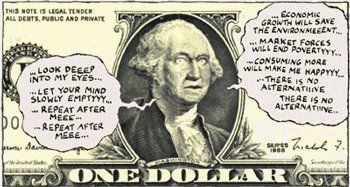
HypnoticDollar

CASSE is engaged in a most interesting discussion with the outstanding economists at the Global Development and Environment Institute (GDAE)
about how the field of Ecological Economics treats money. The discussion began in the Triple Crisis Blog with Alejandro Nadal’s article, “Money Matters, Mr. Daly.” Herman Daly and I both posted comments there, adding to comments from Kevin Gallagher and Neva Goodwin, and The Daly News also featured two essays on money: Daly’s “Money and the Steady State Economy,” and “Money is a COW” by me. Nadal has responded with a follow-up on the macroeconomics of sustainability. Please follow the discussion and weigh in with your comments.
Source: http://steadystate.org/