quarta-feira, 28 de dezembro de 2011

Neil Postman: Amusing Ourselves to Death

Public Discourse in the Age of Show Business

The prophetic landmark work exploring the corrosive effects of electronic media on a democratic society

Originally published in 1985, Neil Postman’s groundbreaking polemic about the corrosive effects of television on our politics and public discourse has been hailed as a twenty-first-century book published in the twentieth century. Now, with television joined by more sophisticated electronic media—from the Internet to cell phones to DVDs—it has taken on even greater significance. Amusing Ourselves to Death is a prophetic look at what happens when politics, journalism, education, and even religion become subject to the demands of entertainment. It is also a blueprint for regaining controlof our media, so that they can serve our highest goals.

Lester Brown: Plan B 4.0 - Mobilizing to Save Civilization

http://books.wwnorton.com/books/Plan-B-40/

"[Brown's] ability to make a complicated subject accessible to the general reader is remarkable."-Katherine Salant, Washington Post

As fossil fuel prices rise, oil insecurity deepens, and concerns about climate change cast a shadow over the future of coal, a new energy economy is emerging. Wind, solar, and geothermal energy are replacing oil, coal, and natural gas, at a pace and on a scale we could not have imagined even a year ago. For the first time since the Industrial Revolution, we have begun investing in energy sources that can last forever. Plan B 4.0 explores both the nature of this transition to a new energy economy and how it will affect our daily lives.

terça-feira, 27 de dezembro de 2011

Helga Dittmar: Consumer Culture, Identity and Well-Being


Series Edited by Professor Rupert Brown.

Series: European Monographs in Social Psychology series.

Advertising, materialism and consumption are central aspects of contemporary Western culture. We are bombarded with idealised images of the perfect body, desirable consumer goods, and affluent lifestyles, yet psychology is only just beginning to take account of the profound influence these consumer culture ideals have on individuals’ sense of identity and worth.

Consumer Culture, Identity, and Well-Being documents the negative psychological impact consumer culture can have on how individuals view themselves and on their emotional welfare. It looks at the social psychological dimensions of having, buying and wanting material goods, as well as the pursuit of media-hyped appearance ideals. In particular, it focuses on:

  • The purchasing of material goods as a means of expressing and seeking identity, and the negative consequences of this
  • Psychological buying motivations in conventional buying environments and on the Internet
  • The unrealistic socio-cultural beauty ideals embodied by idealized models.

Throughout, different approaches from social psychology are integrated, such as self-completion, self-discrepancy and value theory, to create a comprehensive theoretical framework for understanding the impact of internalising core consumer culture ideals on how individuals see themselves and the implications this has for their psychological and physical health.

Consumer Culture, Identity, and Well-Being is of interest to anybody who wants to find out more about the psychological effects of living in modern consumer societies on children, adolescents, and adults. More specifically, it will be of interest to students and researchers in social psychology, sociology, media studies, communication and other social sciences, as well as to psychologists, health workers, and practitioners interested in the topics of identity, consumption pathologies, body image, and body-related behaviours.

sábado, 10 de dezembro de 2011

What's the Economy For, Anyway? By John de Graaf and David K. Batker


Named Best Business Book for Fall 2011 by Publishers Weekly

The question no one ever bothered to ask about the economy: How can we make it work for us, instead of the other way around?

In this funny, readable, and thought-provoking book based on the popular film of the same name, activists John de Graaf (coauthor of the bestselling Affluenza) and David Batker tackle thirteen economic issues, challenging the reader to consider the point of our economy. Emphasizing powerful American ideals, including teamwork, pragmatism, and equality, de Graaf and Batker set forth a simple goal for any economic system: The greatest good for the greatest number over the longest run. Drawing from history and current enterprises, we see how the good life is achieved when people and markets work together with an active government to create a more perfect economy-one that works for everyone.

Beginning by shattering our fetish for GDP, What's the Economy For, Anyway? offers a fresh perspective on quality of life, health, security, work-life balance, leisure, social justice, and perhaps most important, sustainability. This sparkling, message-driven book is exactly what those lost in the doldrums of partisan sniping and a sluggish economy need: a guide to what really matters, and a map to using America's resources to make the world a better place.

terça-feira, 22 de novembro de 2011

Where is future growth in GDP going to come from? THE GROWTH CONUNDRUM

Most forecasts for the world economy, world energy supply and demand, climate change and the economy and so on assume that economic growth will march on.  The Stern report on climate change and the economy said it would “not be unreasonable” to assume the world economy will grow by 2% to 3% annually this century, based on historical growth.  So, what does this growth look like?

The first graph at the top of the page shows the projection of Gross World Product to 2100 at 2% or 3% annual growth, with 2009 indicated.  The second graph shows world ecological footprint: we started using up the biocapacity of the planet faster than it can regenerate by the 1980s. But footprint and GDP (or GWP) correlate very closely: the bigger GDP is, the more energy and material we put through the economy - for food, transportation, the amenities of home and workplace, basically everything we consume.  We’re getting more efficient, but not fast enough.

The top graph to the right shows growth in GDP up to 2009 - a sharply rising exponential growth curve.  In the past 50 years, growth in GWP has averaged about 4% per year.  The last graph shows what this growth has done to the biosphere and how clearly economic growth correlates with exponential increase in human use of natural resources - paper consumption, fish consumption, use of freshwater and soil resources, extinction of species, fertilizer use, and so on (thank you Gus Speth!!). 

So, if the economy is going to go from $61 trillion in GWP in 2009 to somewhere between $450 and $1100 trillion in GWP in 2100, what kind of energy and material throughput are we talking about?  What kind of ecological footprint, if we are already overconsuming the Earth by 20%?  For anyone who thinks runaway banks and credit derivative swaps are the major problem facing the world (and that kind of financial shenaniganism is a HUGE problem, yes), take a close look at these graphs.  They tell the story of the real long-term crisis we are facing.

For a PDF with these graphs, click here:  Growth presentation PDF.pdf

domingo, 20 de novembro de 2011

The Future of Money : New Lenses of Wealth

http://www.emergence.cc/wp-content/files/FOM_infographic_1280x1811.png

Click the above image to open a 1280px x 1811px PNG file in a new window.
2010 BY-NC-SA Emergence Collective
Research and concept by Gabriel Shalom, Venessa Miemis and Jay Cousins.
Design by Patrizia Kommerell.

After several months of research and graphic design we’re happy to present you with our infographic The Future of Money: New Lenses of Wealth. It represents the aggregation of our research on emerging marketplaces, platforms, tools, initiatives and opportunities for the new economy.

quarta-feira, 9 de novembro de 2011

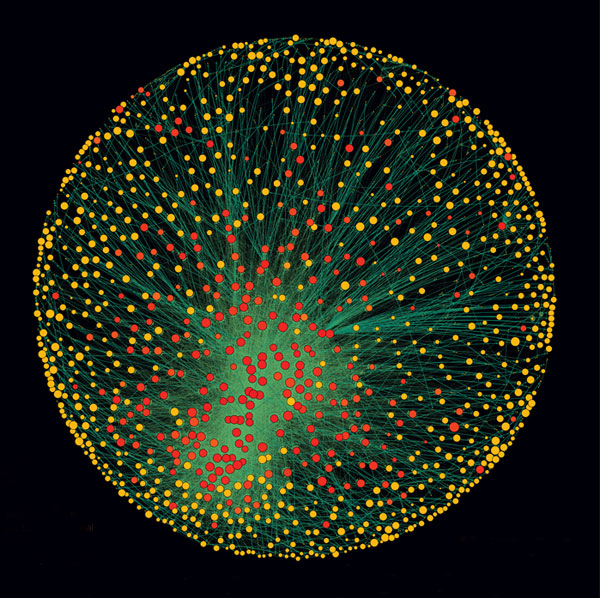
The network that runs the world

http://makewealthhistory.files.wordpress.com/2011/11/network.jpg

This image shows the connections between the 1,318 biggest companies in the world, mapped according to share ownership out of an original 43,000 companies. At the core are 147 super-connected companies, the ones in red. That group, less than one percent of the whole, effectively controls 40% of global revenue. No prizes for guessing which sector dominates that core group. At the top of the tree is Barclays, with JP Morgan Chase, UBS and Merrill Lynch all in the top ten.

This, says the New Scientist, gives credence to the Occupy movement’s claim that the world is run for the benefit of the richest one percent. According to this particular exercise in systems theory, that’s entirely correct.

If you want to check out the methodology, the study is online here (pdf).