Mostrar mensagens com a etiqueta CLASS WAR MATTERS. Mostrar todas as mensagens

sexta-feira, 19 de outubro de 2012

Dennis Gilbert : The American Class Structure in an Age of Growing Inequality - Eighth Edition

http://www.sagepub.com/books/Book234285

In this Eighth Edition of his acclaimed and thought-provoking text, author Dennis Gilbert explores historical and contemporary empirical studies of class inequality in America through the lens of nine key variables. Focusing on the socioeconomic core of the American class system, Gilbert describes a consistent pattern of growing inequality in the United States since the early 1970s. In his search for the answer to why class disparities continue to increase, Gilbert examines changes in the economy, family life, and politics, drawing on vivid first-person accounts to illustrate the human emotion wrapped up in class issues.

Dennis Gilbert is a professor of Sociology at Hamilton College His primary research interests are Latin American and American class system. Gilbert is the author of The American Class Structure in an Age of Growing Inequality (Sage, 2008), Mexico's Middle Class in the Neoliberal Era (University of Arizona Press, 2007), Sandinistas: the Party and the Revolution (Blackwell, 1988), and La Oligarquía Peruana: Historia de Tres familias (Horizonte, 1982). In 1990, he was research director to the successful congressional campaign of Bernard Sanders (Independent-VT) and later served as legislative assistant in Representative Sanders' congressional office. At Hamilton, Gilbert teaches a course on public opinion polling. In collaboration with the polling firm Zogby International, Gilbert and his students have conducted a series of widely reported national surveys, most examining the views of high school students, on such topics as gun control, gay rights, abortion, Muslims in America and patriotism.

quinta-feira, 17 de maio de 2012

sexta-feira, 30 de março de 2012

The Working Class Majority : America's Best Kept Secret, Second Edition

http://www.cornellpress.cornell.edu/book/?GCOI=80140100797250

"Zweig's investigation of politics goes beyond the electoral, focusing instead on how a broad working-class social movement (often in alliance with segments of the professional middle class) could reshape workplace and community power relations as well as national politics."—The Nation

"Those who take (rather than give) orders at work are the working class; at 62 percent of the labor force, they are a majority distracted and diverted from its best interests for several generations. Zweig suggests the implications of this analysis for a number of key political issues, including the 'underclass,' 'family values,' globalization, and what workers get (and should get) from government. Putting class back on the table produces a thoughtful, provocative analysis of where the nation is going and what working people could do about it."—Booklist

"In this pungent critique of class and economics in the United States —part economic theory, part political lecture, and part reportage of working-class life—Zweig offers an insightful, radical analysis that will make many readers rethink commonly held but unexamined beliefs. Zweig supports his arguments with statistics, facts and personal stories and argues with a forcefulness and conviction backed by a deeply moral sense of the dignity that is due to each person in their work and workplace."—Publishers Weekly

“Michael Zweig provides us with a much needed discussion of class in contemporary American society. While students can benefit from the exposure to a perspective that is currently missing from the public landscape, union organizers and activists can also profit from his discussions of worker power and the rebirth of a democratic social movement among working people.”—Contemporary Sociology

- From reviews of the first edition

In the second edition of his essential book—which incorporates vital new information and new material on immigration, race, gender, and the social crisis following 2008—Michael Zweig warns that by allowing the working class to disappear into categories of “middle class” or “consumers,” we also allow those with the dominant power, capitalists, to vanish among the rich. Economic relations then appear as comparisons of income or lifestyle rather than as what they truly are—contests of power, at work and in the larger society.

Michael Zweig is a professor of economics and director of the Center for Study of Working Class Life at the State University of New York at Stony Brook, where he has received the SUNY Chancellor's Award for Excellence in Teaching. He is active in his union, United University Professions (AFT Local 2190), representing 35,000 faculty and professional staff throughout SUNY and has been elected to two terms on its state executive board. His earlier books include What's Class Got to Do with It?: American Society in the Twenty-first Century; Religion and Economic Justice; and The Idea of a World University.

terça-feira, 16 de dezembro de 2008

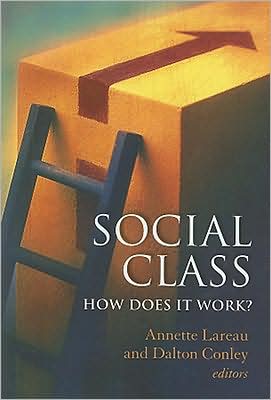
Social Class : How Does it Work?

https://www.russellsage.org/publications/social-class

Class differences permeate the neighborhoods, classrooms, and workplaces where we lead our daily lives. But little is known about how class really works, and its importance is often downplayed or denied. In this important new volume, leading sociologists systematically examine how social class operates in the United States today. Social Class argues against the view that we are becoming a classless society. The authors show instead the decisive ways social class matters—from how long people live, to how they raise their children, to how they vote.

The distinguished contributors to Social Class examine how class works in a variety of domains including politics, health, education, gender, and the family. Michael Hout shows that class membership remains an integral part of identity in the U.S.—in two large national surveys, over 97 percent of Americans, when prompted, identify themselves with a particular class. Dalton Conley identifies an intangible but crucial source of class difference that he calls the “opportunity horizon”—children form aspirations based on what they have seen is possible. The best predictor of earning a college degree isn’t race, income, or even parental occupation—it is, rather, the level of education that one’s parents achieved. Annette Lareau and Elliot Weininger find that parental involvement in the college application process, which significantly contributes to student success, is overwhelmingly a middle-class phenomenon. David Grusky and Kim Weeden introduce a new model for measuring inequality that allows researchers to assess not just the extent of inequality, but also whether it is taking on a more polarized, class-based form. John Goldthorpe and Michelle Jackson examine the academic careers of students in three social classes and find that poorly performing students from high-status families do much better in many instances than talented students from less-advantaged families. Erik Olin Wright critically assesses the emphasis on individual life chances in many studies of class and calls for a more structural conception of class. In an epilogue, journalists Ray Suarez, Janny Scott, and Roger Hodge reflect on the media’s failure to report hardening class lines in the U.S., even when images on the nightly news—such as those involving health, crime, or immigration—are profoundly shaped by issues of class.Until now, class scholarship has been highly specialized, with researchers working on only one part of a larger puzzle. Social Class gathers the most current research in one volume, and persuasively illustrates that class remains a powerful force in American society.

Annette Lareau is a Professor of Sociology at University of Maryland, College Park. Her book, Unequal Childhoods: Class, Race, and Family Life, uses ethnographic methods to examine the impact of social class on children's daily lives. Unequal Childhoods won the best book award for the Sociology of Family Section, the Section on Childhood and Youth, and the Sociology of Culture Section (co-winner) of the American Sociological Association. Her first book, Home Advantage: Social Class and Parental Involvement in Elementary Education is a study of the impact of social class on family-school relationships for parents of children in first grade. Home Advantage won the Willard Waller Award for the Sociology of Education Section of the American Sociological Association. With Jeff Shultz, she is the editor of Journeys Through Ethnography: Realistic Accounts of Fieldwork.

Dalton Conley is University Professor of the Social Sciences and Chair of Sociology at New York University. He also holds appointments at NYU's Wagner School of Public Service, as an Adjunct Professor of Community Medicine at Mount Sinai School of Medicine, and as a Research Associate at the National Bureau of Economic Research (NBER). In 2005, Conley became the first sociologist to win the NSF's Alan T. Waterman Award. His research focuses on the determinants of economic opportunity within and across generations. In this vein, he studies sibling differences in socioeconomic success; racial inequalities; the salience of physical appearance to economic status; the measurement of class; and how health and biology affect (and are affected by) social position.